Aesthetic Surgery
Male Chest Contouring in Bangkok
At YOUNIFY Clinic in Bangkok, male chest contouring starts from THB 120,000; the final plan is confirmed in a written quotation after assessment. Excess gland and fat removed, and the chest border refined into a smooth line with the torso.
Clinic open daily, 11:00 to 20:00 (Bangkok time) · Online enquiries answered 24 hours a day

Price list
| Procedure | Starting Thailand price (฿) | Starting Thailand price (AUD) | Standard Australia price (AUD) |
|---|---|---|---|
| Gynecomastia | |||
| Gynecomastia (Male Breast Reduction) | THB 120,000 | A$5,217 | A$6,574 |
| Chest contouring | |||
| Male Chest Contouring: Liposuction alone (per area) | THB 59,000 | A$2,565 | — |
| Male Chest Contouring: Excision with Liposuction | THB 120,000 | A$5,217 | — |
| Male Chest Contouring: with Skin Adjustment | THB 160,000 | A$6,957 | — |
* Indicative prices for reference only. Some items are priced per area. Final pricing depends on an individual assessment. Overseas prices are indicative market estimates for comparison only. Contact our team for a personalized quote.
Your final quote follows an individual medical assessment. You receive a written quotation before any deposit.
Plan your trip
All figures are approximate and intended for travel planning. Results vary by individual, and your doctor confirms the plan case by case. Please consult a physician before treatment.
Care you can measure
Figures from the YOUNIFY surgical program.
01 · Planning
Separate gland from fat before choosing a technique
The approach depends on what is actually there.
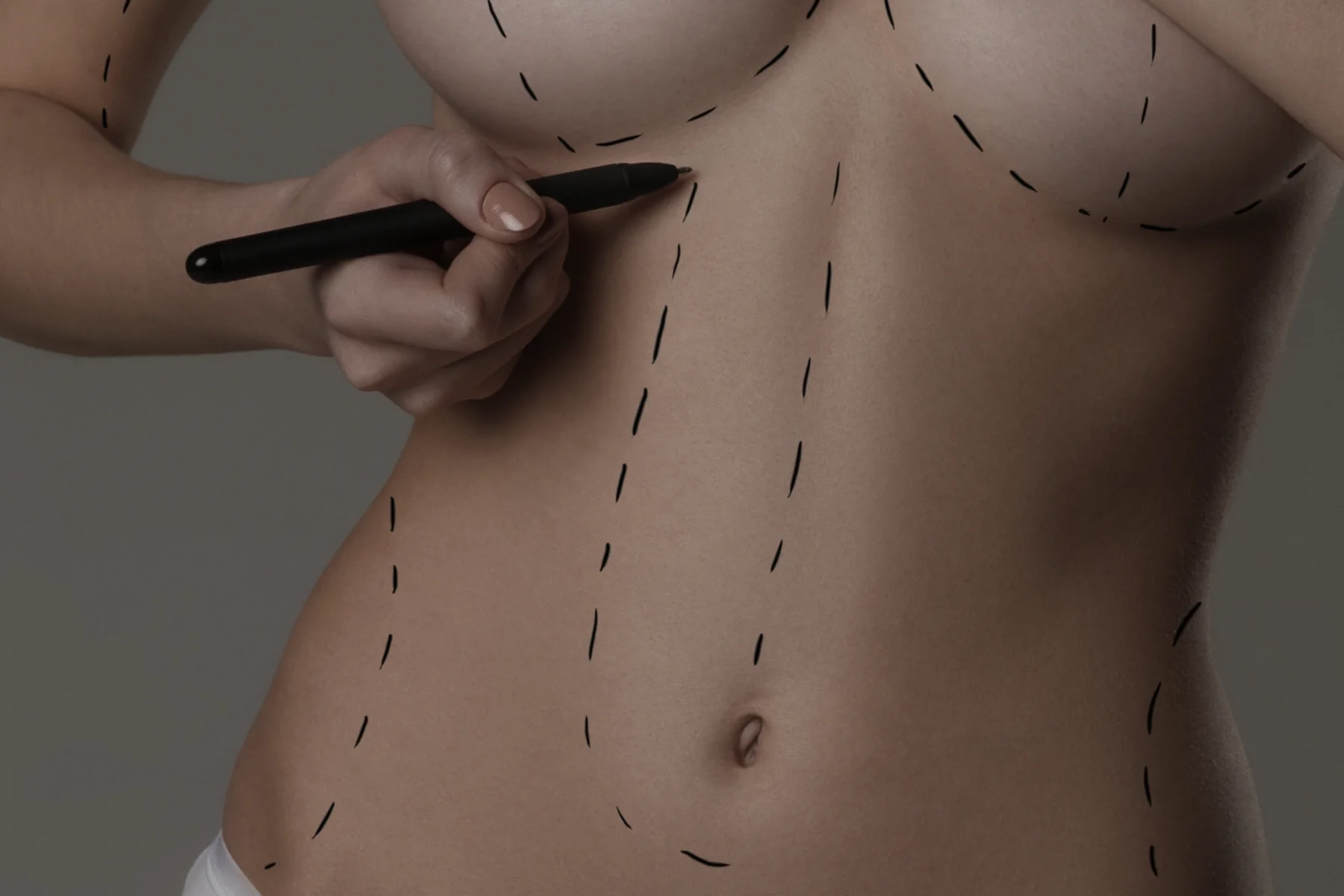
Examination establishes whether the fullness is glandular, fatty or mixed, alongside skin elasticity and nipple position.
Getting that distinction right matters: liposuction alone in a predominantly glandular chest usually leaves a palpable disc and an uneven contour.
Pre-operative assessment is a planning aid. It illustrates an expected direction, not a guaranteed outcome.
What this procedure is
Gynecomastia is an excess of glandular breast tissue, fat, or both in men. Distinguishing gland from fat determines the surgical approach, because fat can be suctioned while glandular tissue has to be excised.
Your surgeon examines the chest to assess the proportion of gland to fat, skin laxity and nipple position, and takes a medication and medical history, because some cases need an underlying cause investigated before surgery is planned.
Before surgery is planned, your physician asks what may be driving the growth. Certain medications, hormonal changes, and some medical conditions can enlarge the male breast, and your physician may ask for blood tests before the operation is confirmed. Where a cause is found, addressing it comes first, because gland removed while the cause continues can grow back. In younger men, gynecomastia that appears in the teenage years often settles on its own, so our surgeons usually wait until the chest has stopped changing.
Concerns it addresses
Predominantly glandular
A firm disc is palpable under the nipple; liposuction alone is not sufficient.
Predominantly fatty
Fullness from diffuse fat, usually related to body weight.
Mixed
Both gland and fat, requiring liposuction together with glandular excision.
With skin laxity
After significant weight loss or long-standing cases, skin may not retract on its own.
How gynecomastia surgery differs from chest liposuction alone
Fullness of the male chest usually comes from two tissues rather than one: a firm disc of glandular tissue beneath the nipple, and softer fat around it. Liposuction removes fat well, but the cannula does not remove the firm gland, so a chest treated with liposuction alone can still look and feel full afterwards. Gynecomastia surgery, also called male breast reduction, removes the gland through a small incision and contours the fat with liposuction in the same session.
| Liposuction alone | Gland excision with liposuction | |
|---|---|---|
| Which pattern it suits | No firm lump under the nipple, with chest fullness mainly from fat | A firm lump under the nipple, which is the most common pattern |
| Method | Fat is suctioned through very small incisions | Glandular tissue is excised alongside liposuction, leaving a thin layer under the nipple |
| Strength | Very small incisions, quick recovery, and even blending of the chest border into the chest wall | Addresses both components in one procedure and avoids a hollow under the nipple |
| What it does not address | Does not reduce glandular breast tissue | Does not address excess skin where laxity is marked |
| Recurrence | Fat can increase again if body weight rises | Excised glandular tissue does not return, although fat can increase again if body weight rises |
| Incision | Millimeter entry points at the chest border | A short incision along the lower edge of the areola, plus the same entry points |
| Anesthesia | Local with sedation or general, depending on the plan | General anesthesia, specialist anesthesiologist present throughout |
| Scar | Small dots that fade | A fine line at the areola border, where the skin color changes |
| Starting from | THB 59,000 per area | THB 120,000 |
How we plan your result
The goal is a chest border that runs smoothly into the chest wall and torso, not the removal of as much tissue as possible. Taking too much gland from directly beneath the nipple can create a saucer deformity that is harder to correct than the original problem.
Who is it for
- Men with chest fullness who feel self-conscious with their shirt off or in fitted clothing
- Men with a palpable firm disc under the nipple assessed as gynecomastia
- Men at a stable weight where the condition has not improved with diet and exercise
- Men in good general health with no untreated underlying medical cause
When we may say no
- A medication or hormonal cause that has not been reviewed, since removing the gland does not remove the cause.
- A chest that is still changing, most often in younger men.
03 · Technique
Liposuction excision, or both
Establishing gland versus fat at examination determines the entire approach.
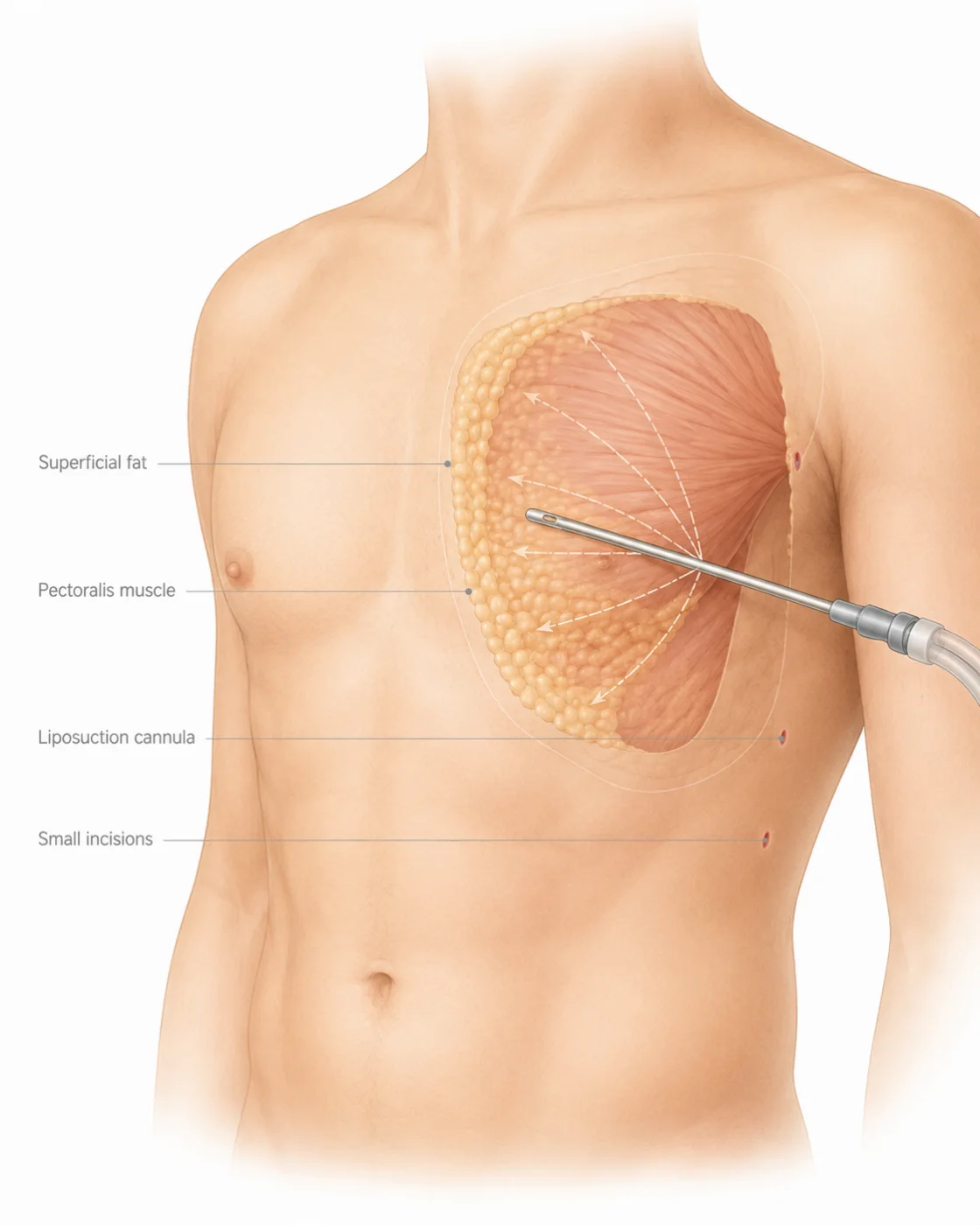
Liposuction alone
Superficial fat is suctioned across the chest through several small incisions at the chest border and axilla.
Benefits: Very small incisions, quick recovery, and the chest border can be feathered evenly into the chest wall.
Suitable for: No palpable firm disc under the nipple, with fullness that is predominantly fatty.
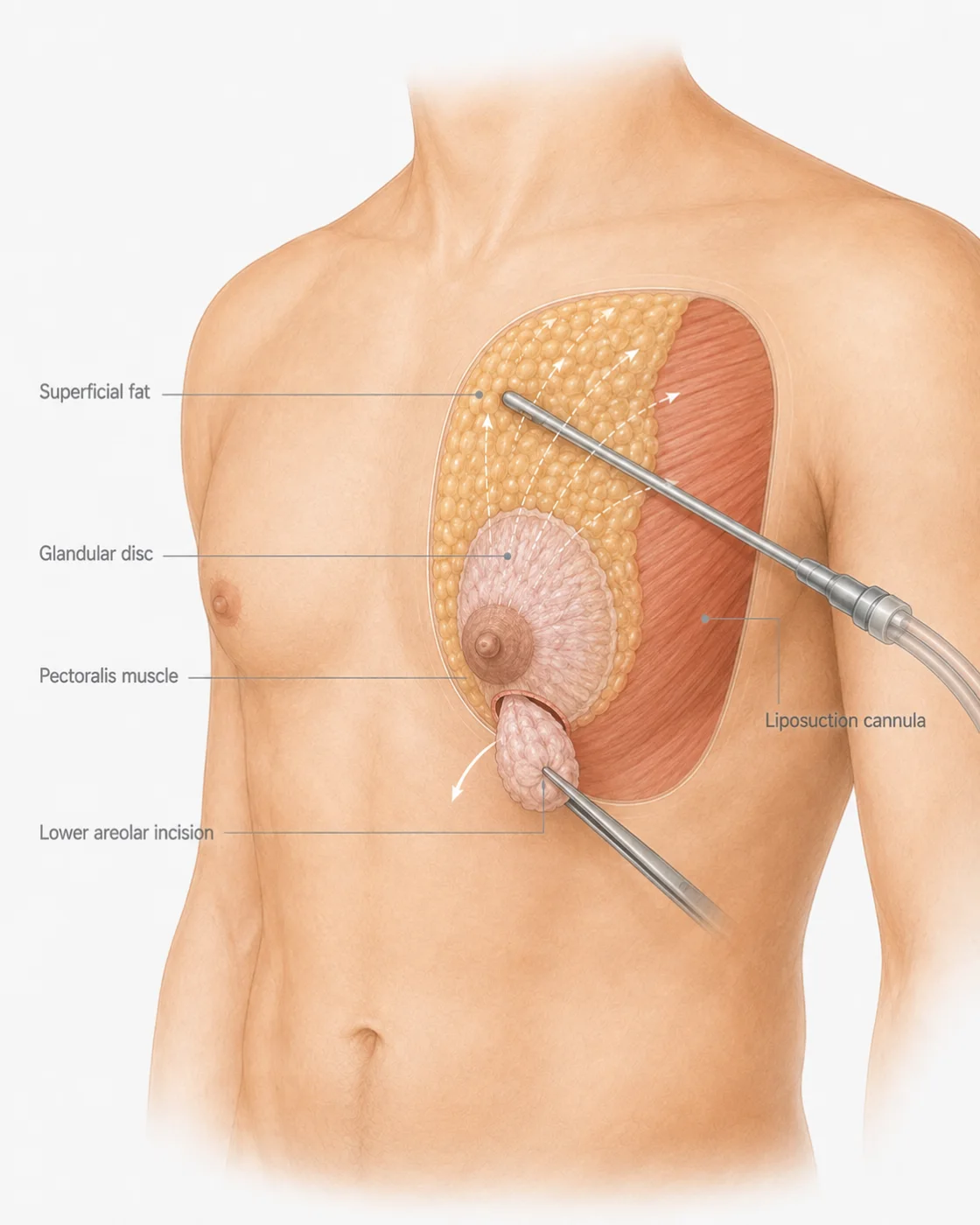
Excision with liposuction
The surrounding fat is suctioned first, then the glandular disc is removed through an incision at the lower areolar border.
Benefits: Addresses both components in one operation, keeping a thin sub-areolar layer so no depression forms.
Suitable for: A palpable firm disc under the nipple: the most common presentation.
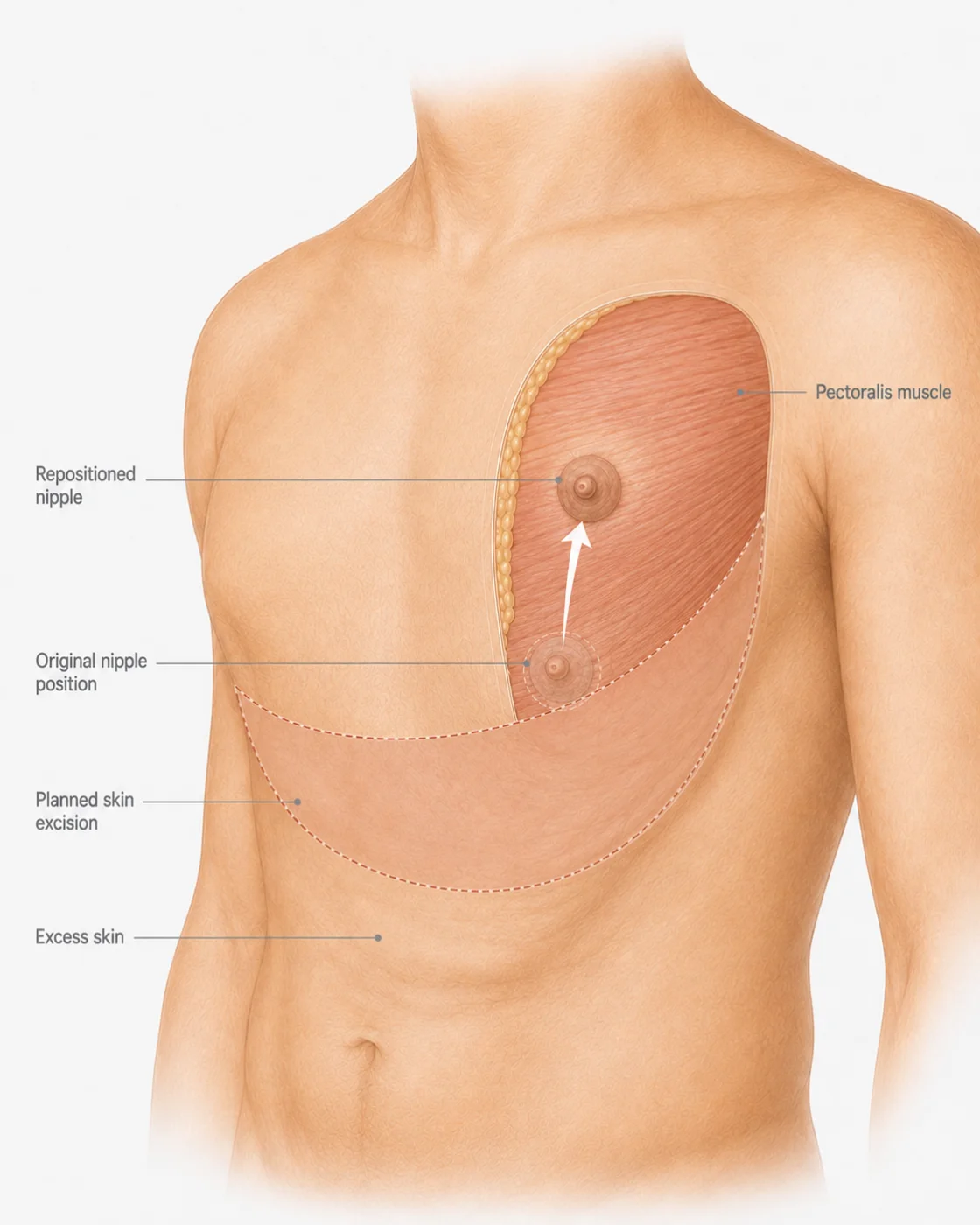
With skin adjustment
Excess skin is removed and the nipple repositioned where the skin will not retract once tissue is taken out.
Benefits: Delivers a genuinely flat chest border where laxity is significant; liposuction alone would leave the skin folded.
Suitable for: Significant weight loss, or long-standing gynecomastia that has stretched the skin.
04 · Your team
Performed by board-certified plastic surgeons
This procedure is performed by the clinic's plastic surgeons at an accredited partner private hospital (JCI / AACI).

Dr. Phattrapohn Liangcheep
Plastic and Reconstructive Surgery
Diploma of the Thai Board of Plastic and Reconstructive Surgery
View full profile
Dr. Thanachot Kamolveerat
Plastic and Reconstructive Surgery
Diploma of the Thai Board of Plastic and Reconstructive Surgery
View full profile05 · Safety
Operating room standards and monitoring
Surgery is performed in the operating room of a JCI- or AACI-accredited partner private hospital, with anesthesia care and continuous monitoring throughout.
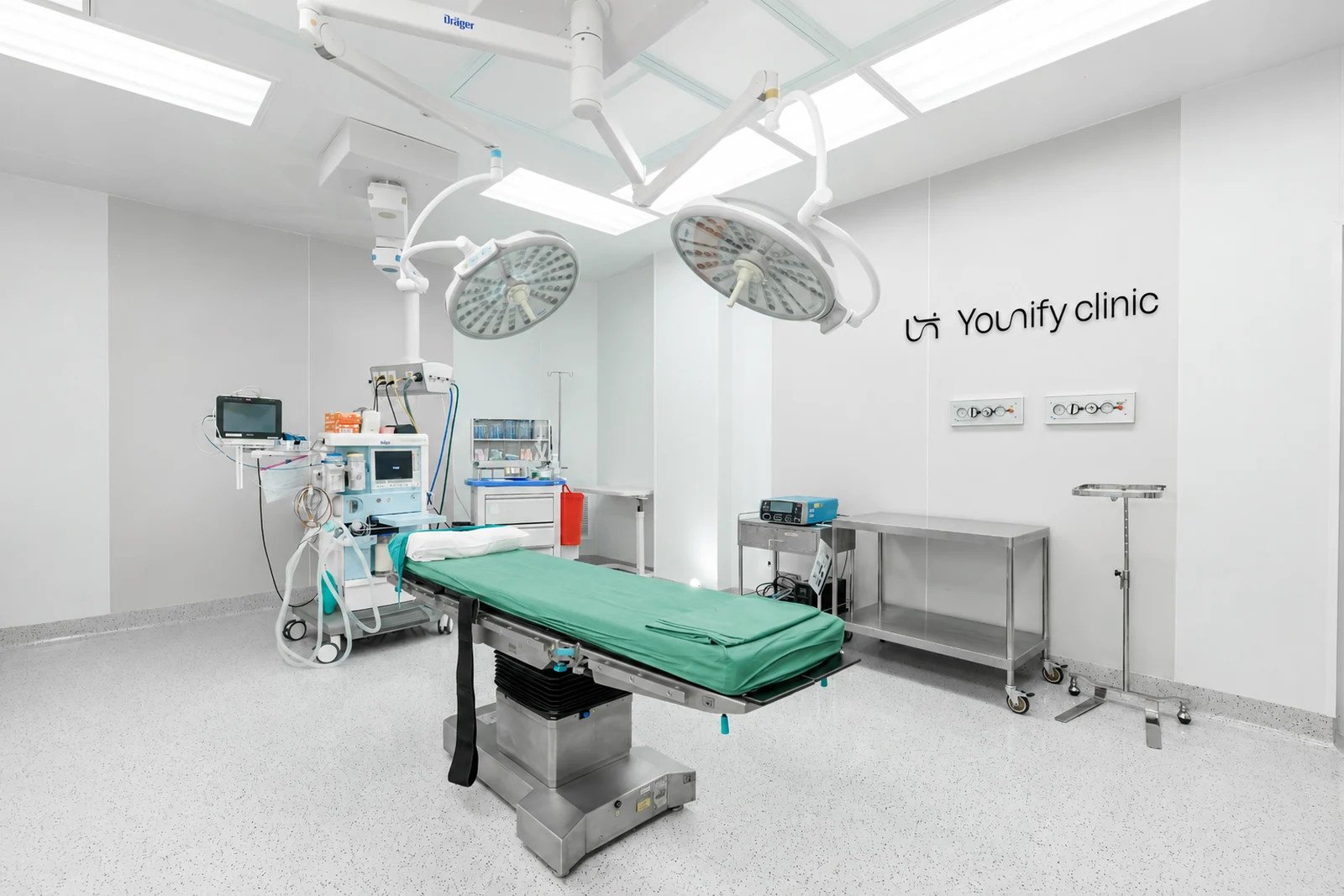
JCI- or AACI-accredited partner private hospital
Procedures are performed in a registered operating room, not a treatment room.
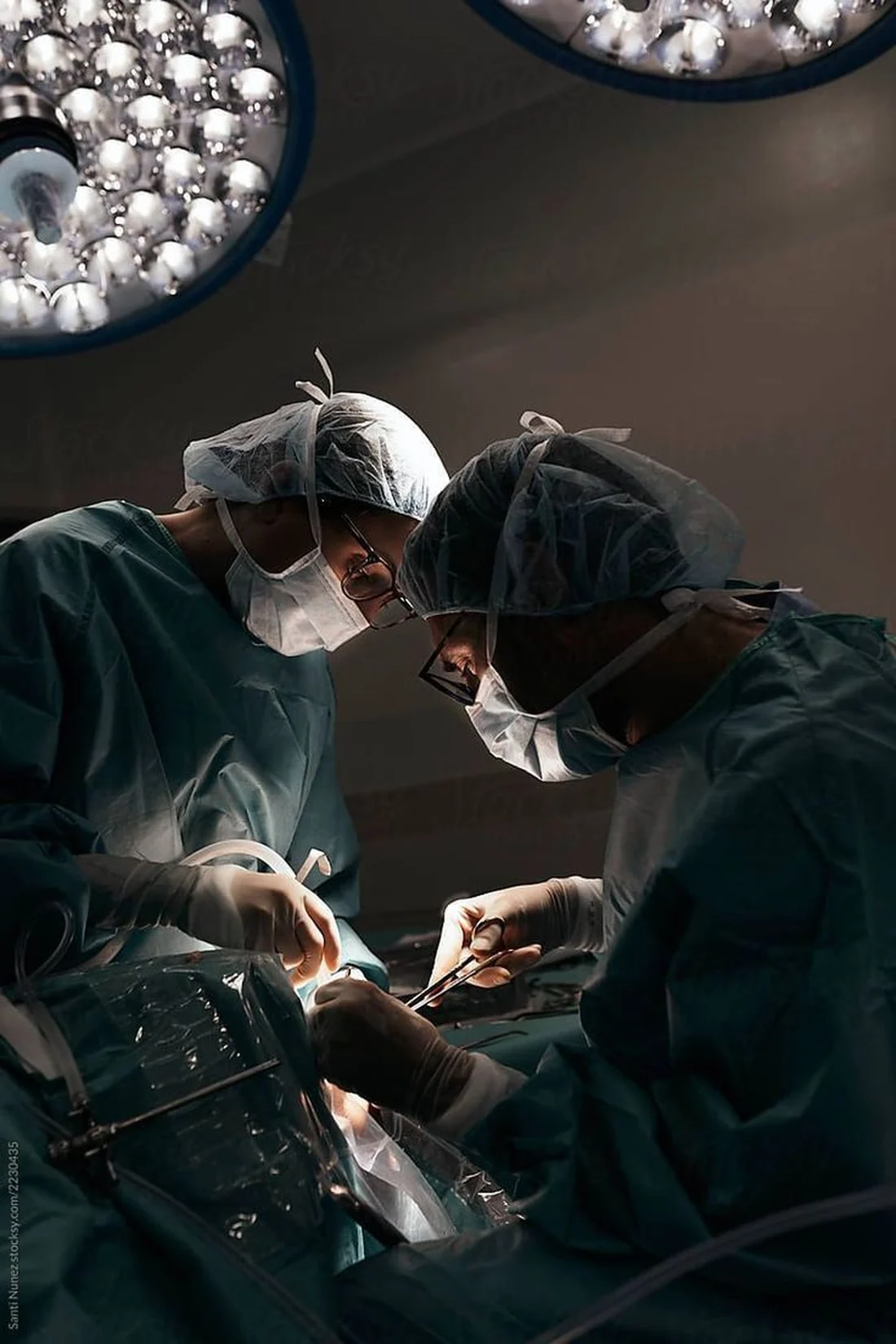
Specialist anaesthesia care
Anaesthesia is administered and monitored by a qualified anaesthesiologist for the duration of surgery.
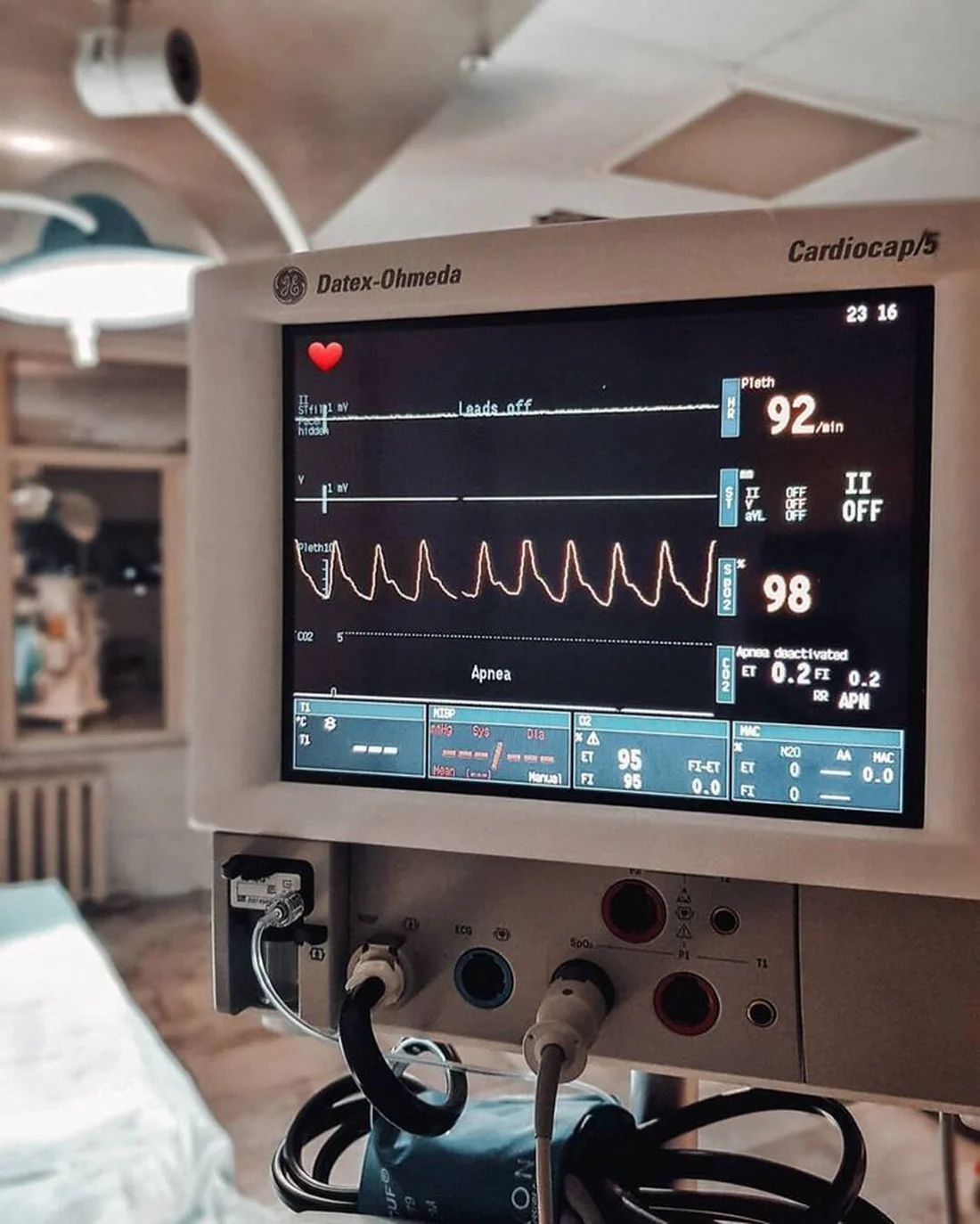
Continuous monitoring
Vital signs are monitored continuously during the procedure and through initial recovery.
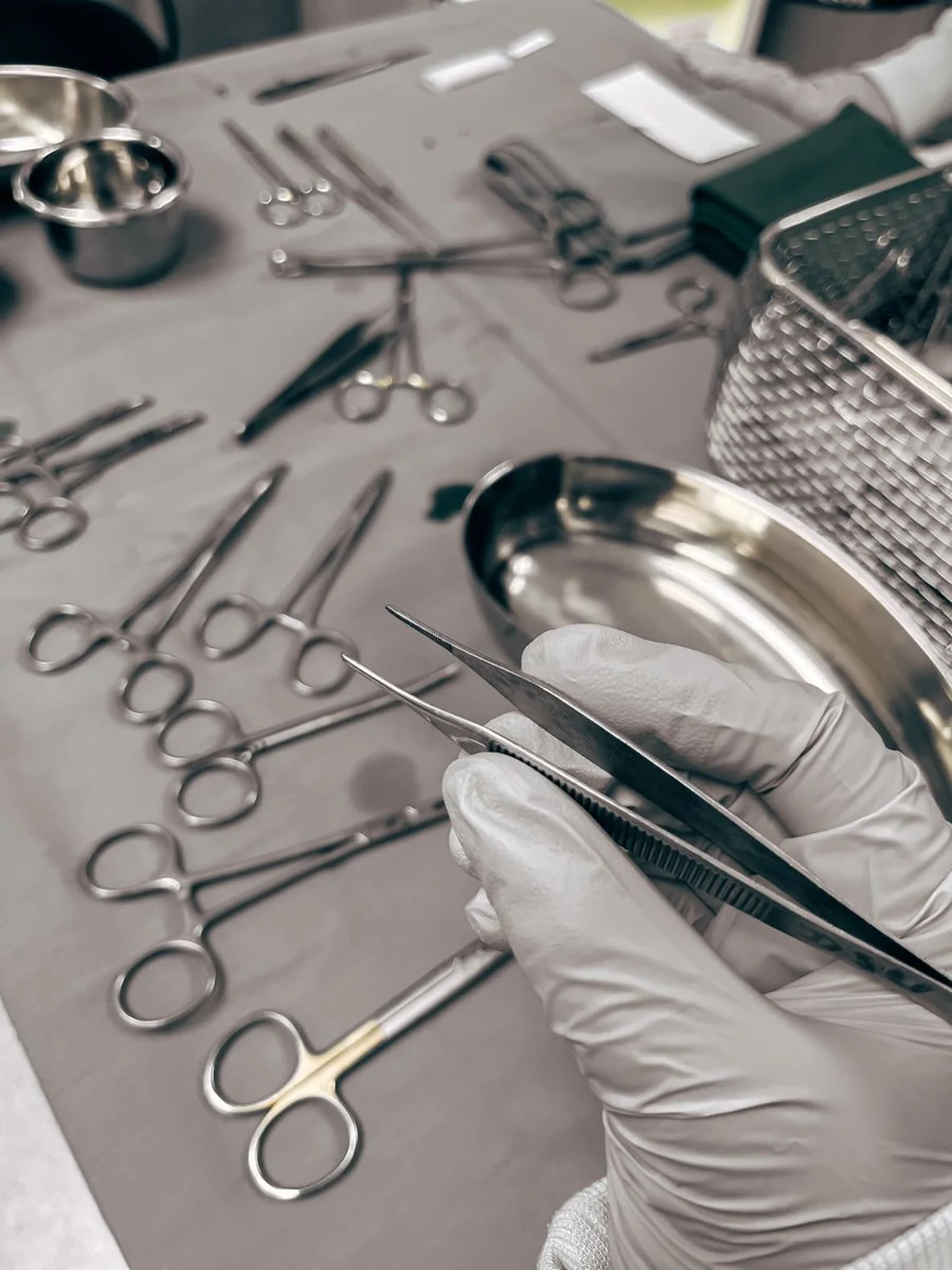
Sterile instrument protocol
Instruments and implants are handled under a documented sterile protocol.
The treatment process
Consultation & examination
Gland-to-fat proportion, skin laxity, and a medication and medical history are assessed.
Investigation where indicated
Some cases need further tests to identify an underlying cause before surgery is planned.
Technique & incision planning
Liposuction, excision or a combination is chosen and incision positions agreed.
Day of surgery
Performed as planned, keeping a sub-areolar tissue layer to prevent a depression.
Aftercare
Compression garment as scheduled, wound care, and no heavy lifting early on.
Follow-up
Wound checks and a contour review once swelling settles.
Recovery timeline
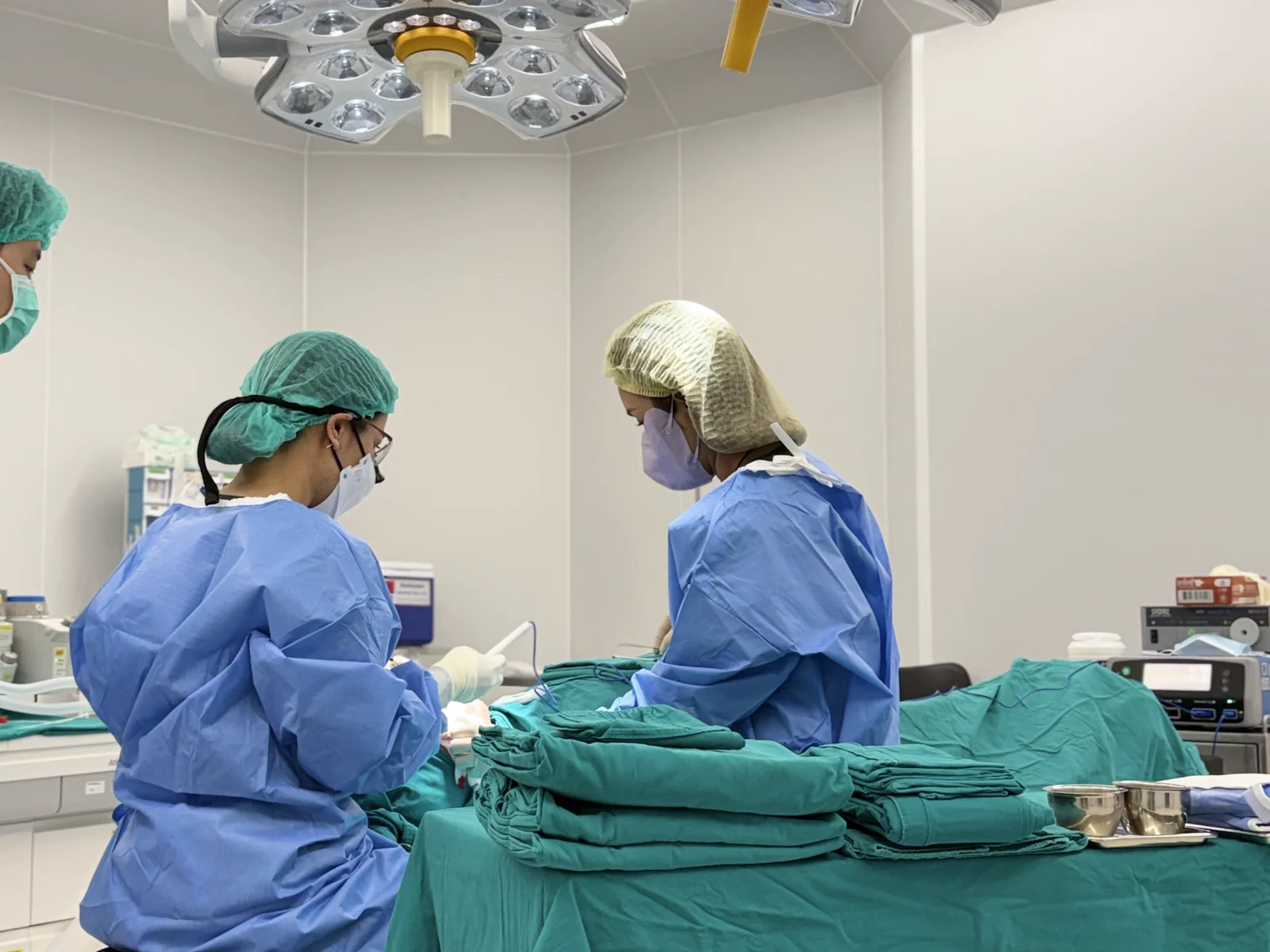
Your surgery at YOUNIFY
From the surgeon who operates to the nurses who follow up, and a private suite to recover in.


Frequently asked questions
How is this different from losing weight?
Weight loss reduces fat but not glandular tissue. Where gland is the main component, diet and exercise alone usually do not flatten the chest.
Can it come back?
Excised gland does not return, but fat can increase with weight gain, and some medications or medical conditions can trigger recurrence.
Where is the scar?
Usually along the lower areolar border, where the colour change helps disguise it, plus small incisions for liposuction.
How long is the garment worn?
Typically 4–6 weeks. The exact period depends on the extent of surgery and individual healing.
Can liposuction alone treat gynecomastia?
Only when the fullness is fat alone. Liposuction does not remove the firm glandular disc beneath the nipple, so true gynecomastia treated by liposuction alone can still look and feel full afterwards. Your surgeon decides by examination, and the plan is confirmed in writing before you book.
When can I go back to the gym?
Walking begins the same day and light lower-body activity usually resumes within the first weeks. Chest, shoulder, and heavy upper-body training wait until your surgeon clears them, typically several weeks after surgery, with the compression vest worn as directed until then.
* This information is for general education. Results and treatment plans depend on an individual medical assessment. Every procedure carries risk. Please consult a doctor before deciding.
Related procedures
Considering male chest contouring?
Book an assessment and an individual plan with the YOUNIFY Clinic medical team.
Medically reviewed by Dr. Noppachai Siranart · Last reviewed
Surgery is performed by the clinic's two board-certified plastic surgeons at JCI- or AACI-accredited partner private hospitals in Bangkok.
Individual results may vary. Please consult a doctor before treatment.