Breast & Body
Breast Augmentation in Bangkok
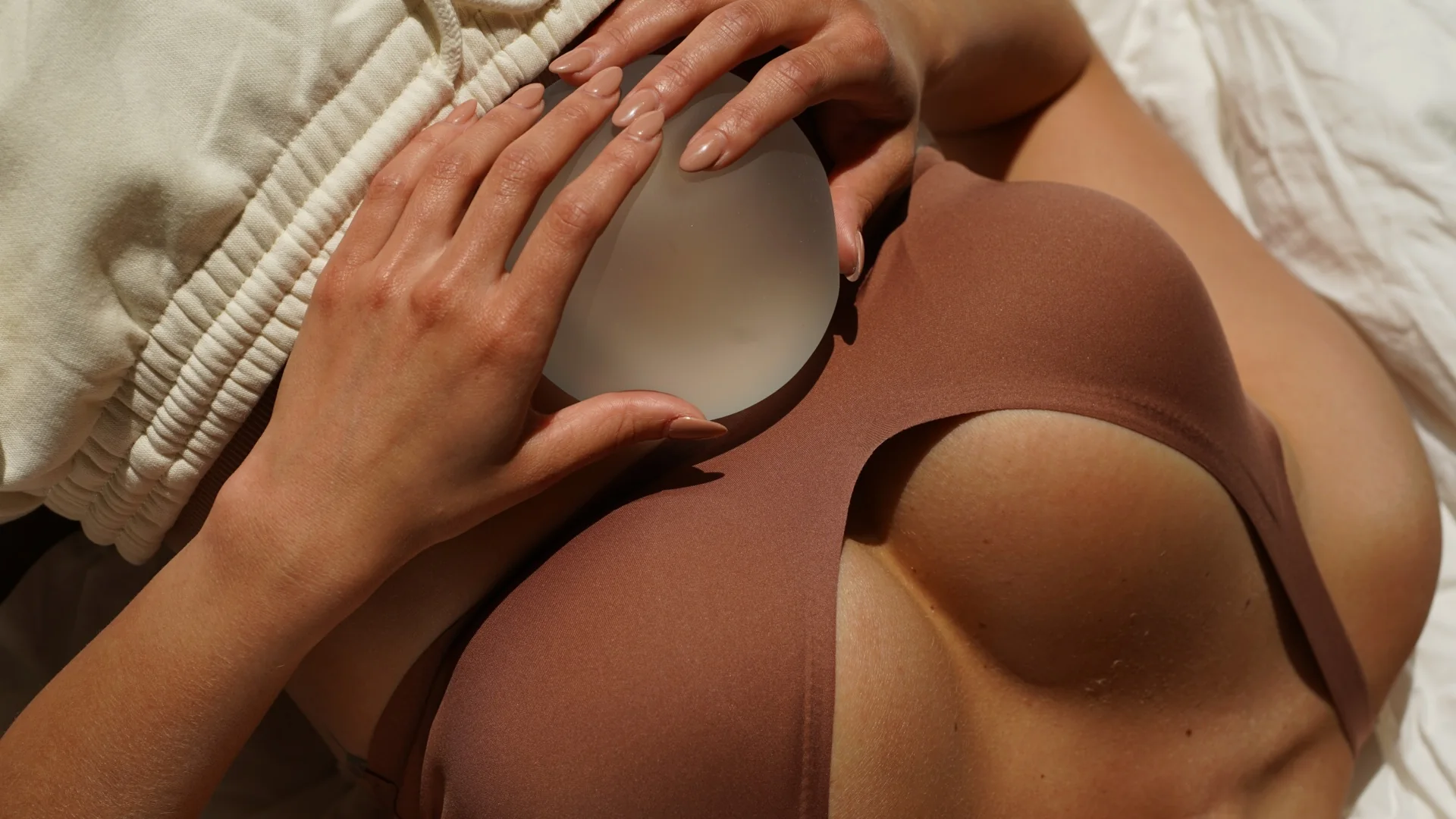
Breast augmentation at YOUNIFY Clinic, Silom, Bangkok, is planned from your own chest and torso measurements rather than a cup size, using implants or your own fat. Each plan is drawn up by Thai Board-certified plastic surgeons, with a written quotation after consultation. Most patients fly home within 7 to 10 days; results vary by individual.
Clinic open daily, 11:00 to 20:00 (Bangkok time) · Online enquiries answered 24 hours a day

Price list
Procedures in this table start from THB 48,000 to THB 290,000 per procedure; the final plan is confirmed in a written quotation after assessment.
| Procedure | Starting Thailand price (฿) | Starting Thailand price (AUD) | Standard Australia price (AUD) |
|---|---|---|---|
| Breast Augmentation | |||
| Breast Augmentation (Saline or Silicone Implants) | THB 132,000 | A$5,739 | A$12,000 |
| Breast Augmentation with Fat Transfer | THB 179,000 | A$7,783 | A$17,000 |
| Endoscopic Breast Augmentation | THB 290,000 | A$12,609 | A$20,000 |
| Male Breast Augmentation | THB 162,000 | A$7,043 | A$15,000 |
| Breast Correction / Revision | |||
| Breast Correction (Tuberous or Asymmetrical Breasts) | THB 59,000 | A$2,565 | A$12,000 |
| Breast Implant Removal | THB 125,000 | A$5,435 | A$12,000 |
| Breast Implant Revision | THB 200,000 | A$8,696 | A$18,000 |
| Nipple & Areola | |||
| Nipple Correction Surgery (Lift / Reduction) | THB 48,000 | A$2,087 | A$4,500 |
| Areola Reduction | THB 48,000 | A$2,087 | A$4,500 |
* Indicative prices for reference only. Final pricing depends on an individual assessment. Overseas prices are indicative market estimates for comparison only. Contact our team for a personalized quote.
Your final quote follows an individual medical assessment. You receive a written quotation before any deposit.
Traveling from overseas? See the Thailand package for this procedure.
View the Thailand packagePlan your trip
All figures are approximate and intended for travel planning. Results vary by individual, and your doctor confirms the plan case by case. Please consult a physician before treatment.
See the process and our care
Care you can measure
Figures from the YOUNIFY surgical program.

01 · Planning
Preview your shape before the day of surgery
Feel more confident about the size and shape you choose.
Three-dimensional simulation lets you and your surgeon look at how different implant volumes and profiles may sit on your own chest structure, before anything is decided.
Together you can compare options against your base width, tissue thickness, and body proportions, so the plan is discussed with a shared picture rather than described in words.
Simulation is a planning aid. It illustrates an expected direction, not a guaranteed outcome.
What is breast augmentation?
Breast augmentation increases the size and refines the shape of the breasts using medical-grade silicone implants, creating balanced proportions tailored to each individual.
Our surgical team assesses your chest structure, skin, and goals to choose the right implant size, shape, and placement, all through a small, well-hidden incision.
Concerns it addresses
Small / disproportionate breasts
Low volume, or breasts that do not match your frame, leaves the silhouette unbalanced.
Asymmetry
A noticeable difference in size or shape between the two sides.
Deflation after pregnancy / breastfeeding
Loss of volume and upper-pole fullness after pregnancy or nursing.
Constricted / tuberous shape
A narrow base or congenital tuberous shape that needs tailored planning.
02 · Materials
Certified implants, matched to your anatomy
We use registered medical-grade silicone implants. Your surgeon recommends the model whose base width, profile, and shell suit your tissue. The brand is chosen to fit the plan, not the other way around.
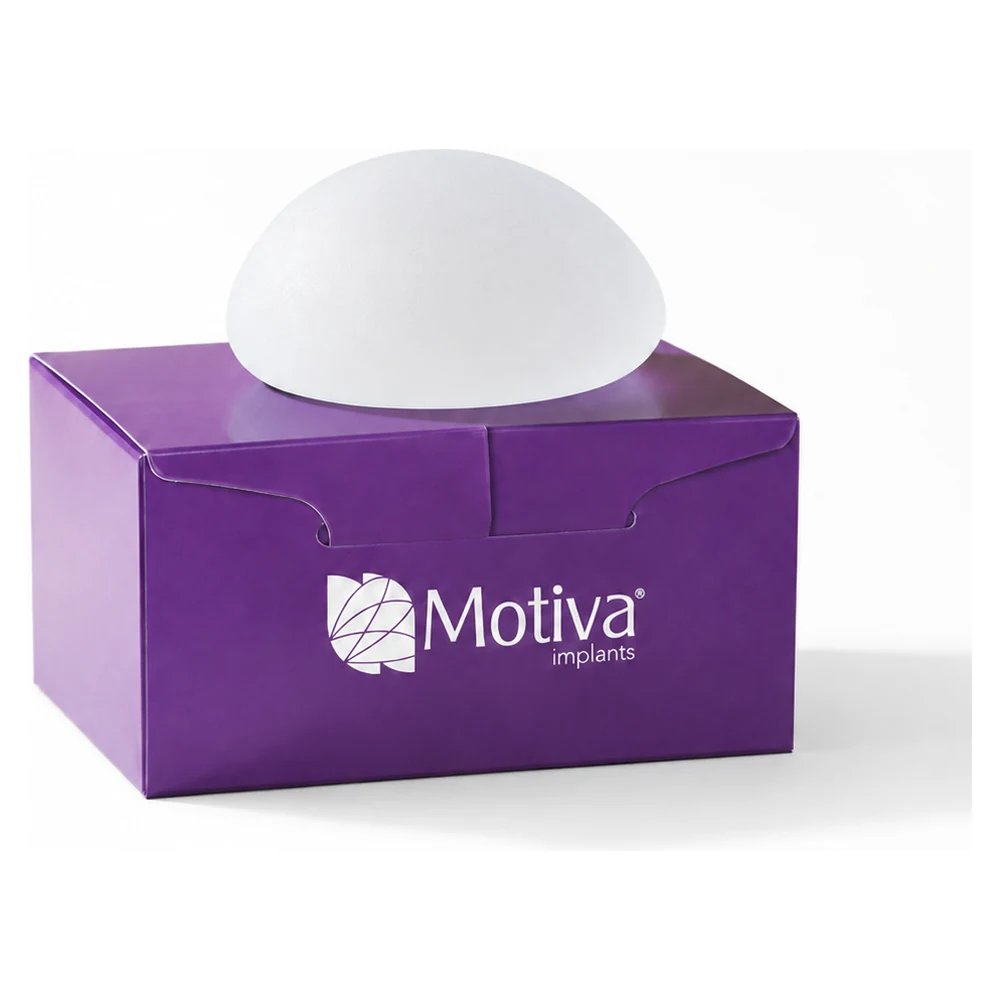
Motiva
Smooth surface · ergonomic gel
- SurfaceSmoothSilk / SilkSurface
- GelErgonomix responsive gel that shifts with body position
- Suited toPatients who want a soft, natural-moving result
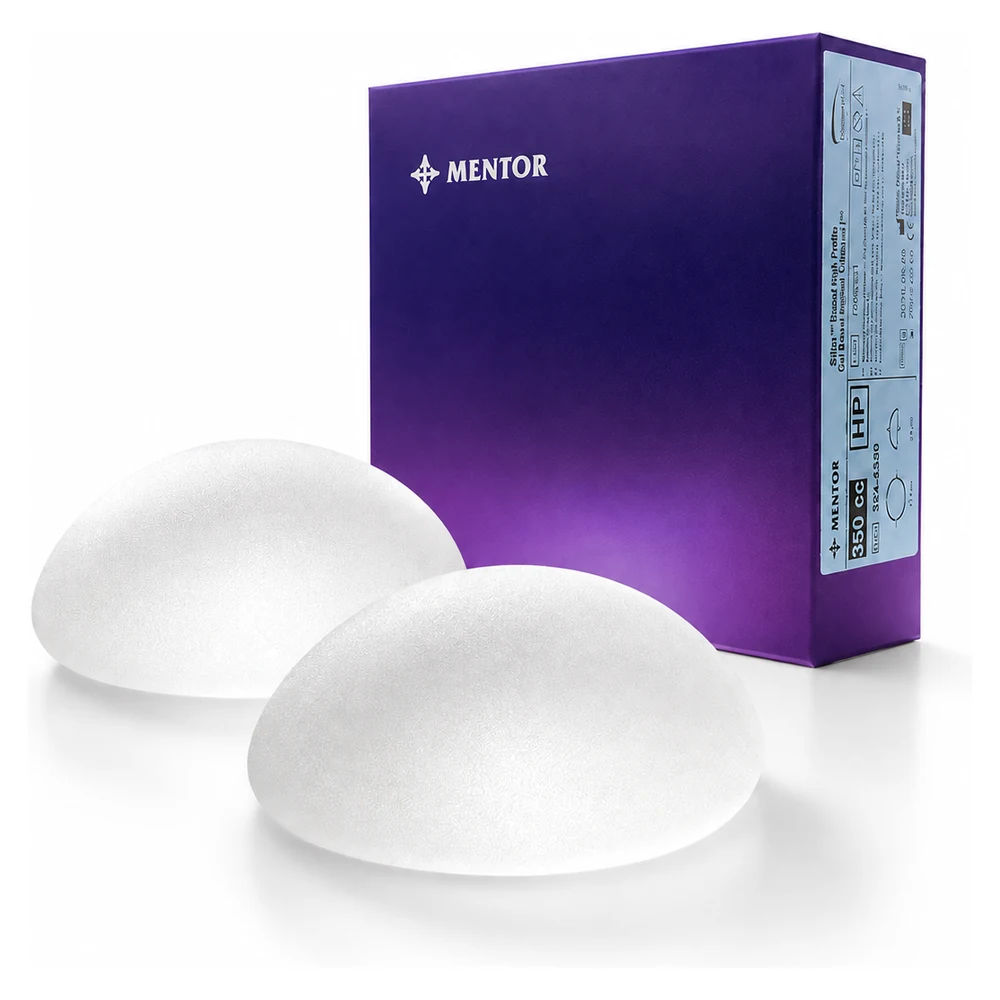
Mentor
Smooth surface, stable shape
- SurfaceSmooth shell
- GelMemoryGel cohesive silicone
- Suited toPatients who want added fullness with a shape that holds well over time
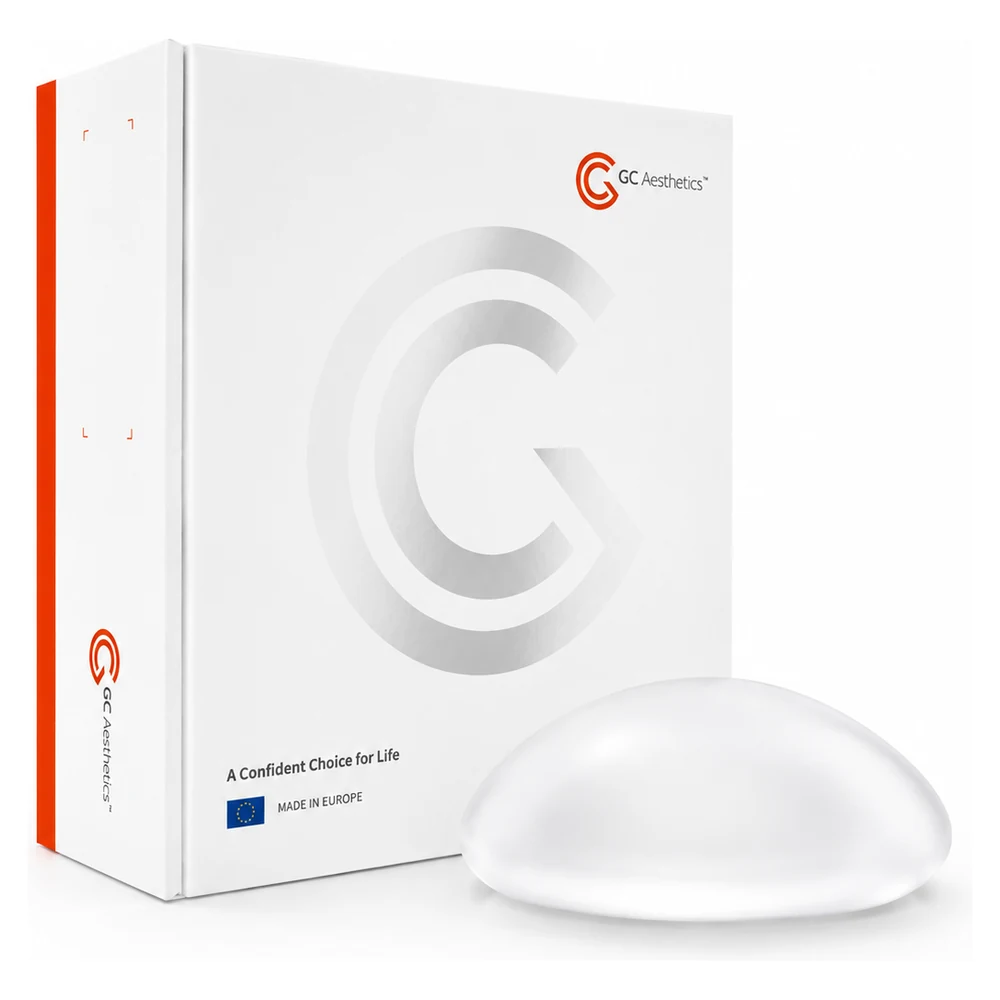
Perle
Nano-textured surface, smooth contour
- SurfaceBioQ nano-textured surface
- GelCohesive silicone gel
- Suited toA soft, natural-looking contour with reduced concern about rippling
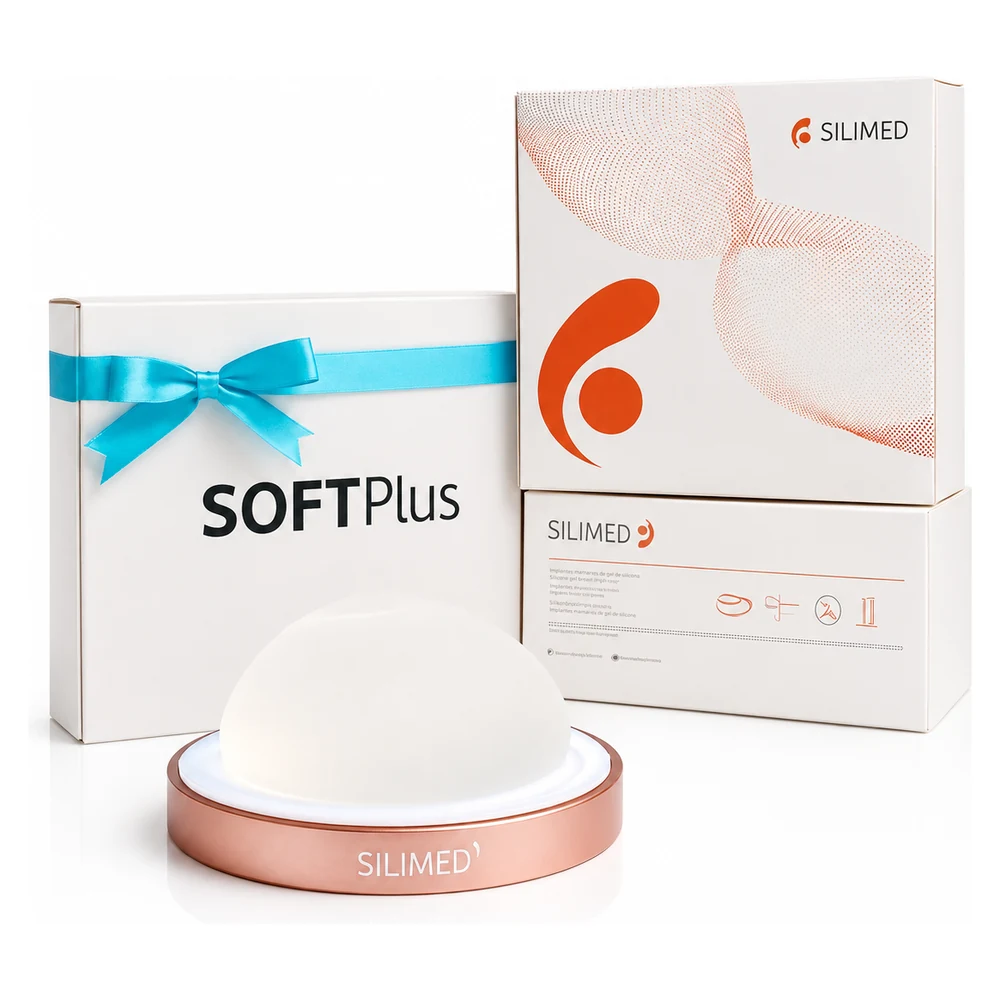
Silimed
Designed for shape stability
- SurfaceTextured shell options
- GelCohesive silicone gel
- Suited toPatients who want a fuller shape with stable implant positioning
Implant availability and pricing are confirmed at consultation. Only implants registered with the Thai FDA are used.
Augmentation vs Breast Lift
The two procedures solve different concerns. Your surgeon will help you decide which suits you.
| Augmentation | Breast Lift | |
|---|---|---|
| Primary goal | Adds size and fullness | Lifts sagging breasts to a firmer shape |
| Method | Places silicone implants | Reshapes skin and tissue; usually no implants |
| Fullness | Adds upper-pole fullness | Keeps existing volume, refines shape |
| Nipple position | Stays in place | Raised to a higher position |
| Best for | Smaller breasts or wanting more size | Sagging after pregnancy or weight loss |
How we plan your result
A beautiful result is not the largest cup size: it is proportion to your body. Base width, tissue thickness, and your frame determine the right implant size and shape, so the breast is planned against the whole silhouette rather than a fixed cup size.
Your planning options
Who is it for
- Those who want to increase breast size or fullness
- Those with asymmetry who want a more balanced shape
- Those whose breasts changed after pregnancy or breastfeeding
- Those in good health with no contraindications to surgery
Your approach options
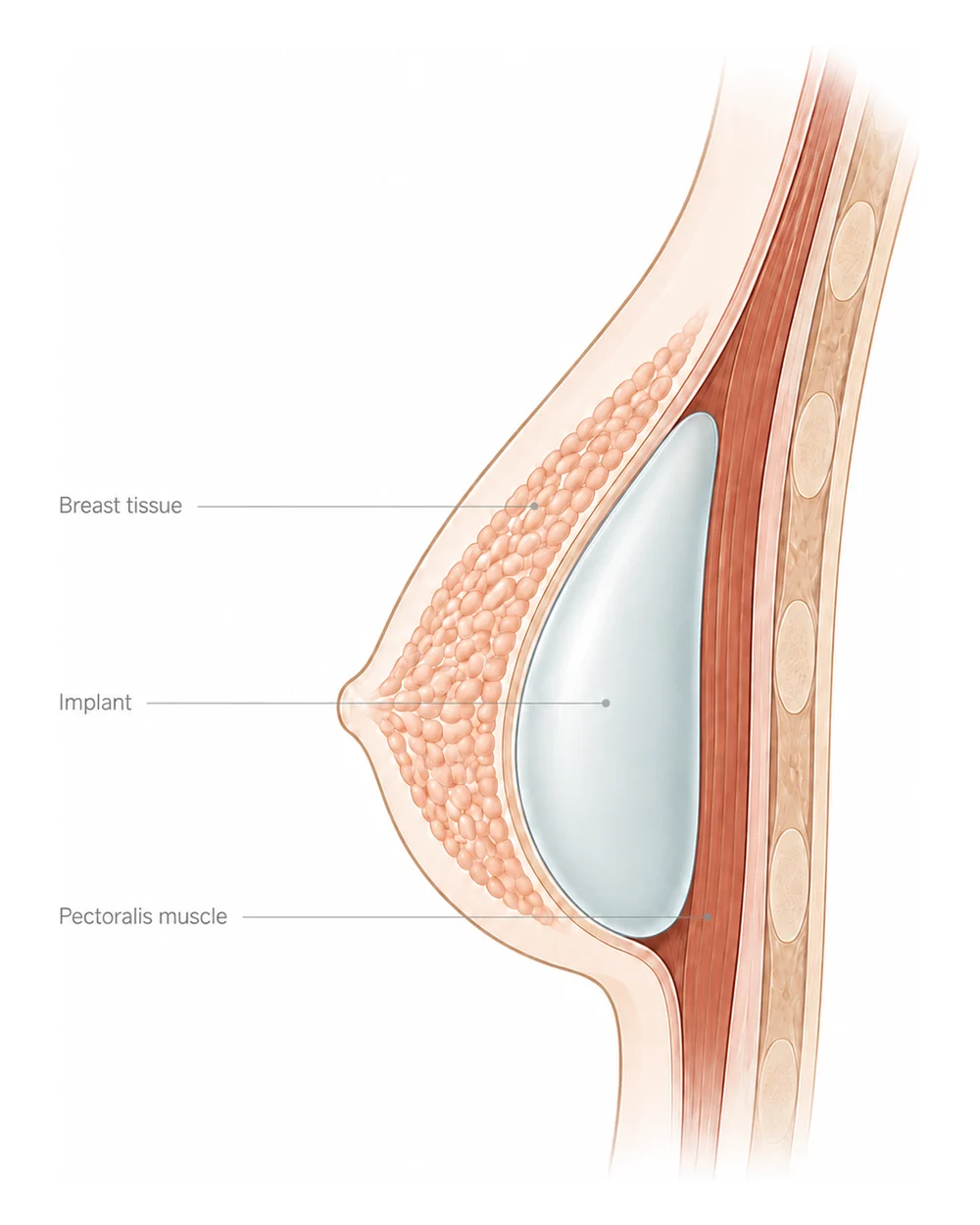
Subglandular (over the muscle)
Advantages · The implant sits beneath the breast tissue but above the pectoralis major, so the muscle is not lifted or stretched. This can mean less discomfort and a shorter early recovery.
Limitations · Generally suited to patients with enough natural breast tissue. With a slim build or little tissue, implant edges may be more visible.
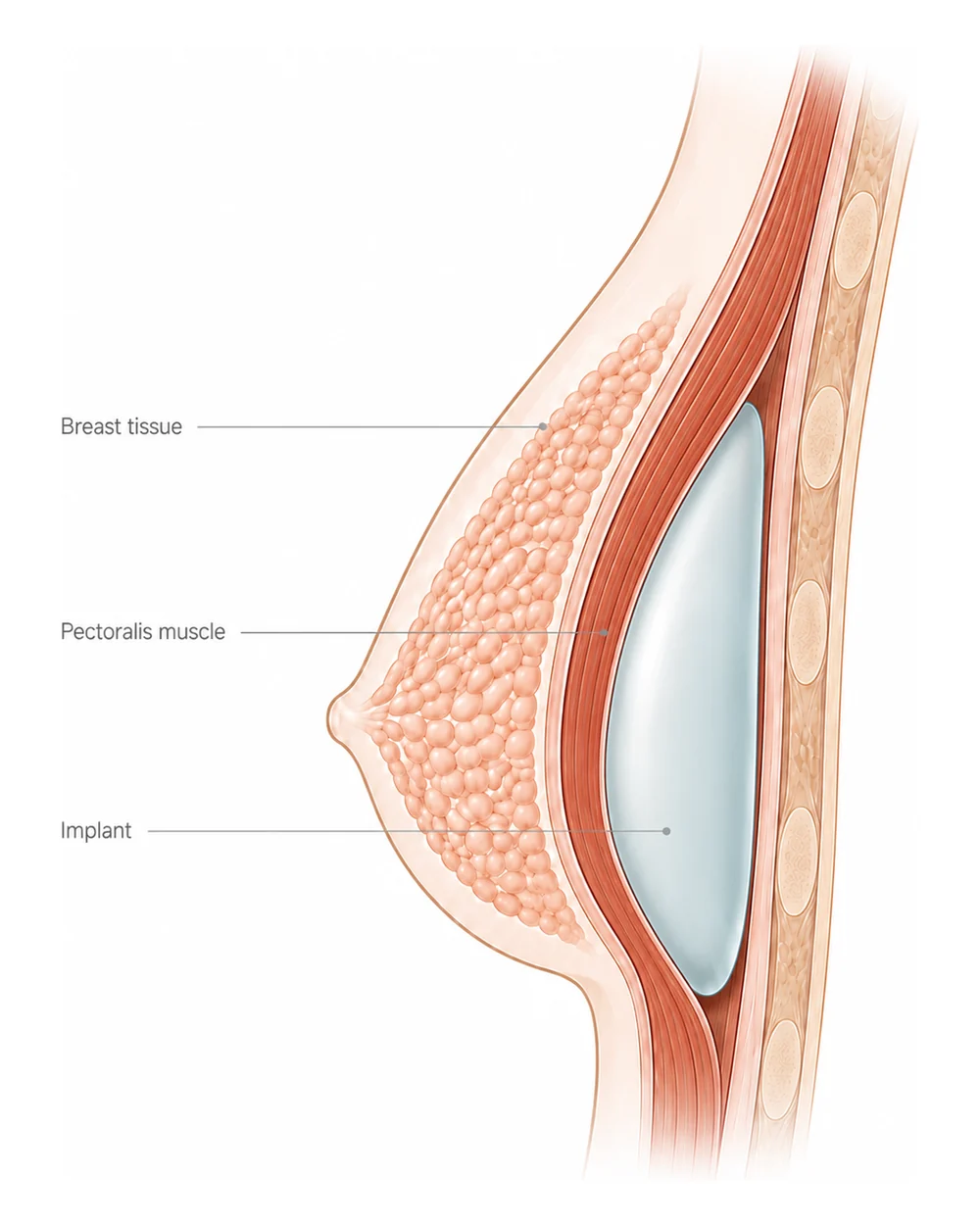
Submuscular (under the muscle)
Advantages · The implant sits fully beneath the pectoralis major, so the muscle layer helps camouflage the implant edges, which is often considered when there is little breast tissue.
Limitations · Early recovery may involve more tightness because the muscle has been stretched, and the breasts take longer to soften and settle.
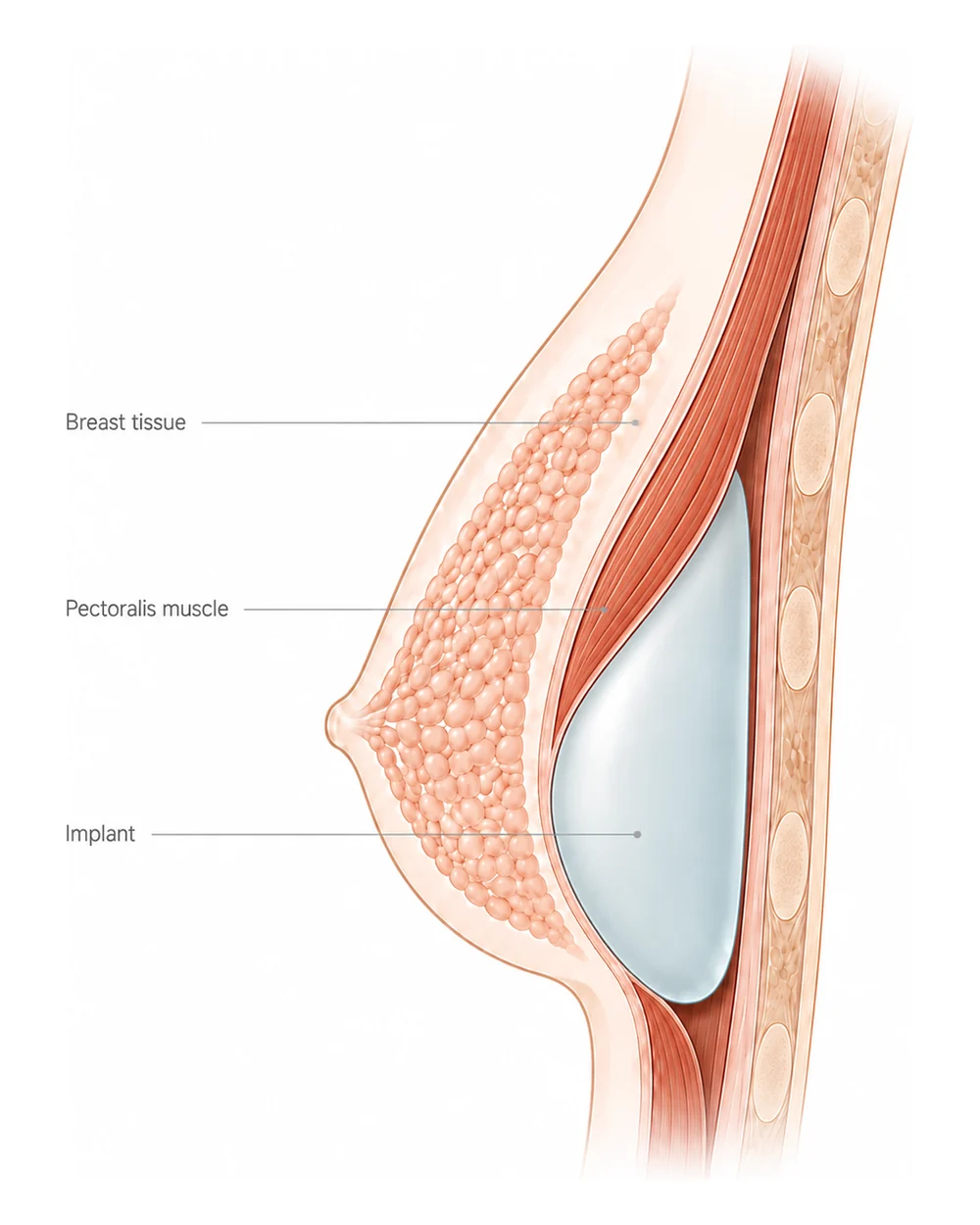
Dual plane
Advantages · The upper part of the implant is covered by the chest muscle while the lower part sits under the breast tissue, aiming for a smooth upper slope with a fuller lower curve.
Limitations · Requires precise anatomical planning and is performed by a specialist plastic surgeon.
03 · Incision
Where the incision is placed
The access point is chosen with you at planning. It affects where the scar sits and how the implant is positioned.
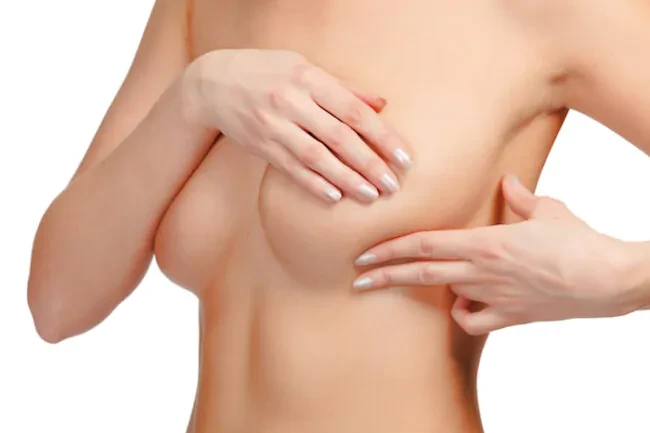
Inframammary incision
Made along the natural crease underneath the breast. It is one of the most common access points for breast augmentation.
Benefits: Gives the surgeon direct access and clear visibility, which supports precise implant positioning, including dual plane placement. The incision is small and sits within the fold.
Suitable for: Patients who want precise control over implant position, or who are having a larger implant placed.
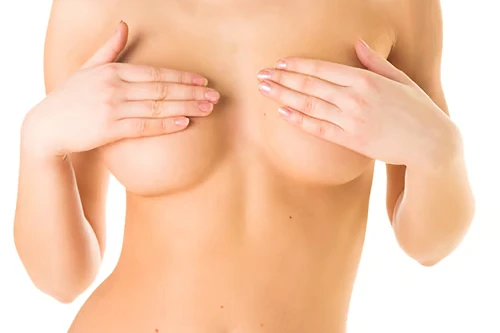
Periareolar incision
Made along the lower edge of the areola, where the change in skin colour helps disguise the scar line.
Benefits: The scar follows an existing colour border on the breast rather than crossing plain skin.
Suitable for: Patients whose areola is large enough for the implant to pass through. Your surgeon will discuss its effect on nipple sensation and breastfeeding before you decide.
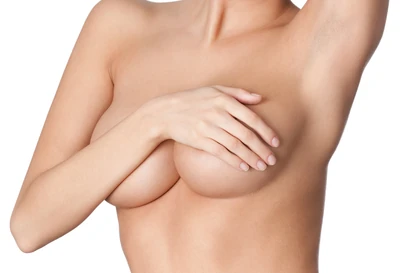
Transaxillary incision
Made within the natural crease of the underarm. The implant is passed through this access point, often with endoscopic assistance.
Benefits: The scar sits in the underarm fold rather than on the breast itself.
Suitable for: Patients who would prefer no incision on the breast, or who often wear low-cut clothing.
04 · Your team
Performed by board-certified plastic surgeons
This procedure is performed by the clinic's plastic surgeons at an accredited partner private hospital (JCI / AACI).

Dr. Phattrapohn Liangcheep
Plastic and Reconstructive Surgery
Diploma of the Thai Board of Plastic and Reconstructive Surgery
View full profile
Dr. Thanachot Kamolveerat
Plastic and Reconstructive Surgery
Diploma of the Thai Board of Plastic and Reconstructive Surgery
View full profile05 · Safety
Operating room standards and monitoring
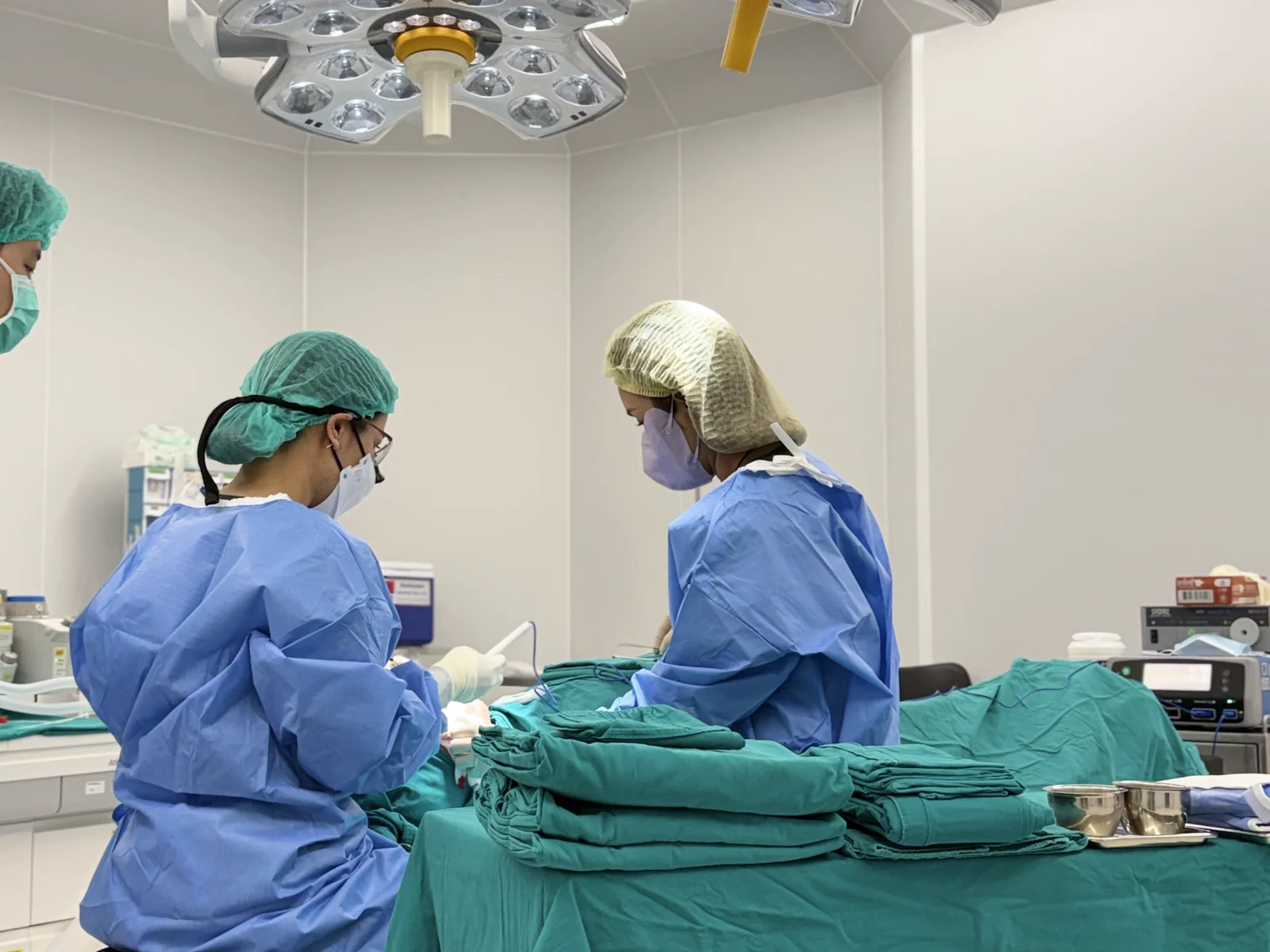
Surgery is performed in the operating room of a JCI- or AACI-accredited partner private hospital, with anesthesia care and continuous monitoring throughout.
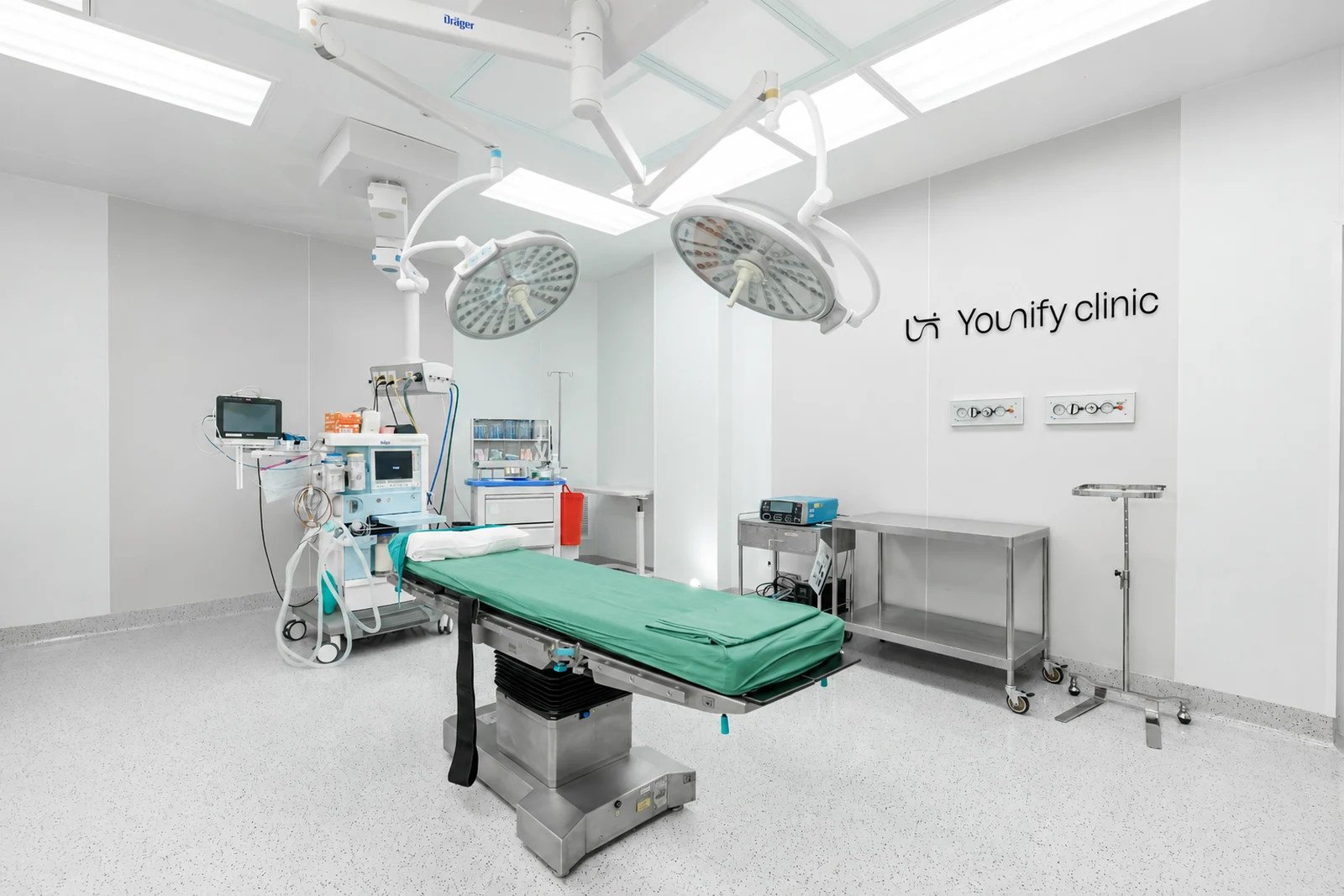
JCI- or AACI-accredited partner private hospital
Procedures are performed in a registered operating room, not a treatment room.
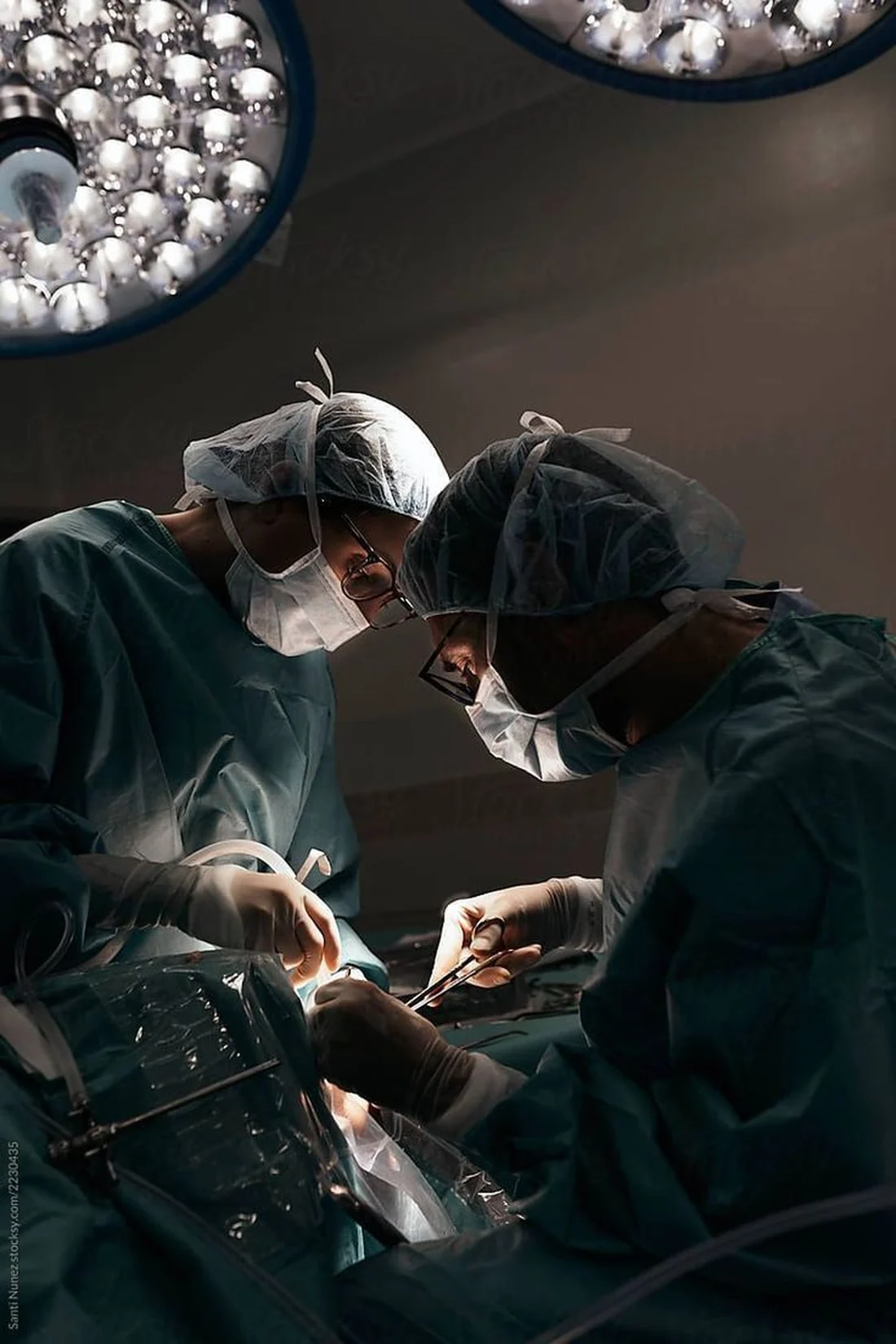
Specialist anaesthesia care
Anaesthesia is administered and monitored by a qualified anaesthesiologist for the duration of surgery.
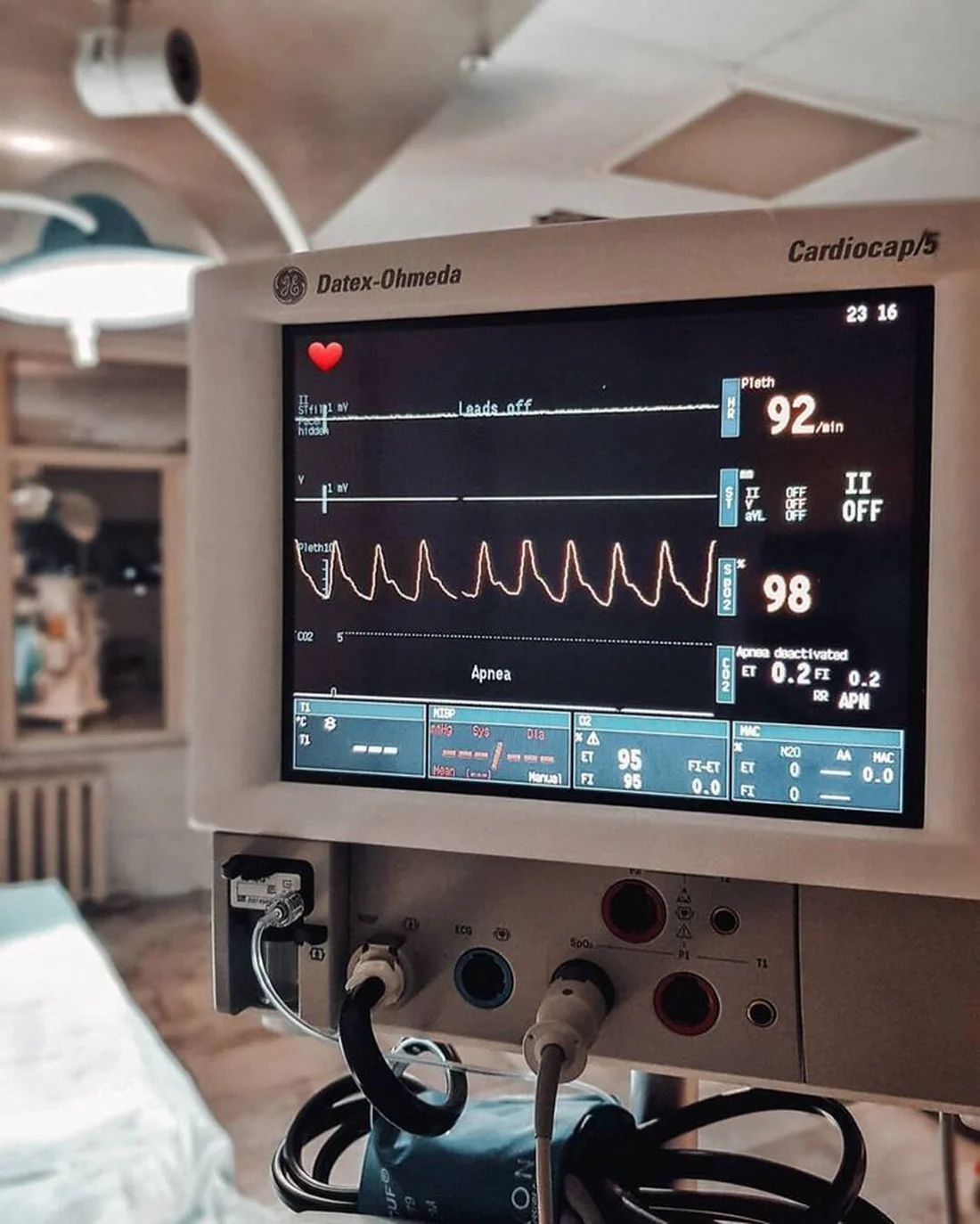
Continuous monitoring
Vital signs are monitored continuously during the procedure and through initial recovery.
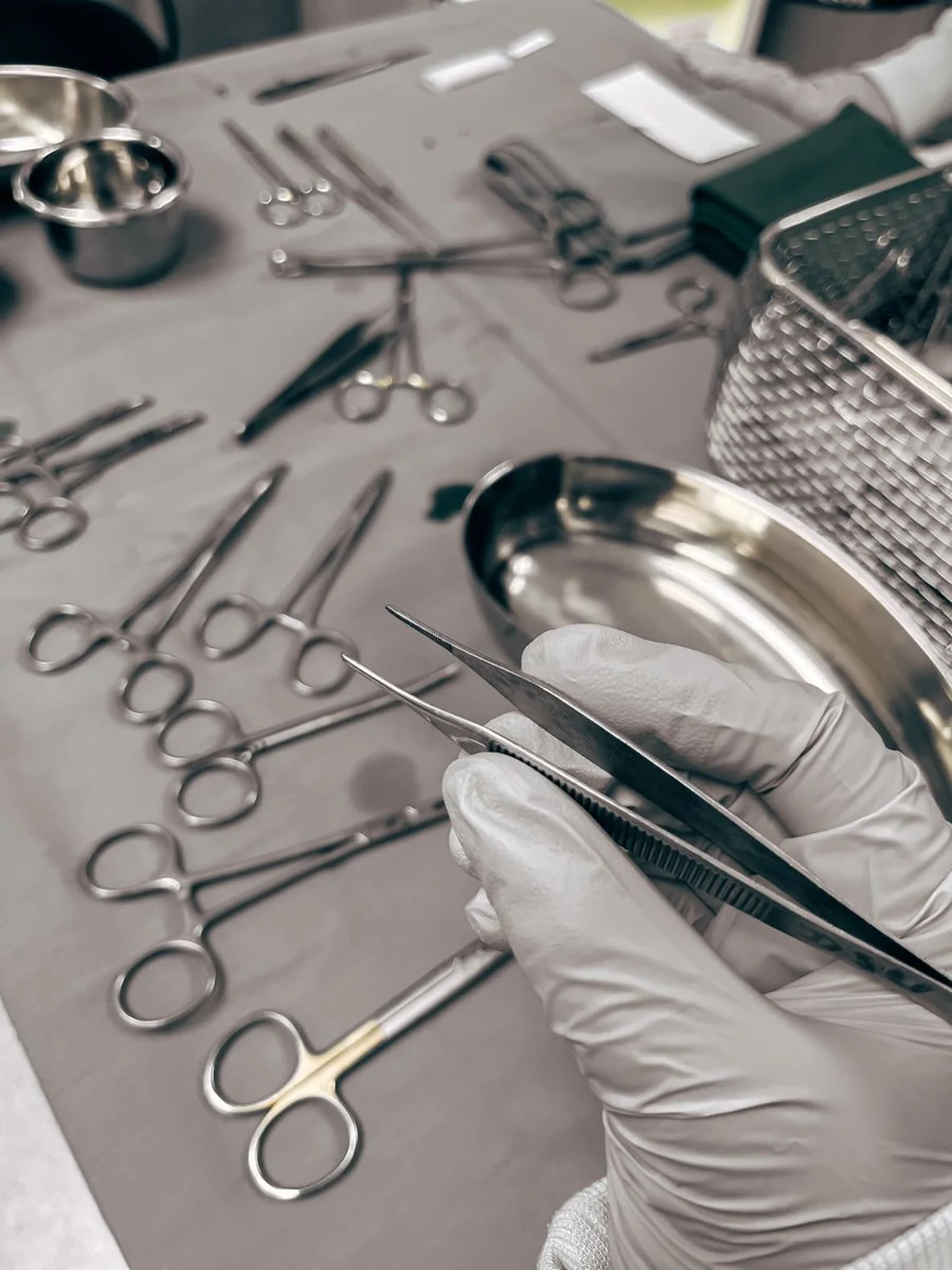
Sterile instrument protocol
Instruments and implants are handled under a documented sterile protocol.
The treatment process
Consult & assessment
Assess base width, tissue thickness, skin elasticity, and any sagging, and hear your goals.
Design size & shape
Choose a volume and shape that suits your frame, with sizers to preview the result.
Select the implant
Choose the medical-grade implant model, surface, and profile by softness and durability.
Plan incision & placement
Finalize the incision site and placement level (over / under muscle / dual plane).
Surgery day
Performed in a standard operating theatre by a specialist surgeon and anesthesia team.
Aftercare
A supportive garment, a swelling program, and implant-position reviews as scheduled.
Recovery timeline
Your surgery at YOUNIFY
From the surgeon who operates to the nurses who follow up, and a private suite to recover in.


Before & After
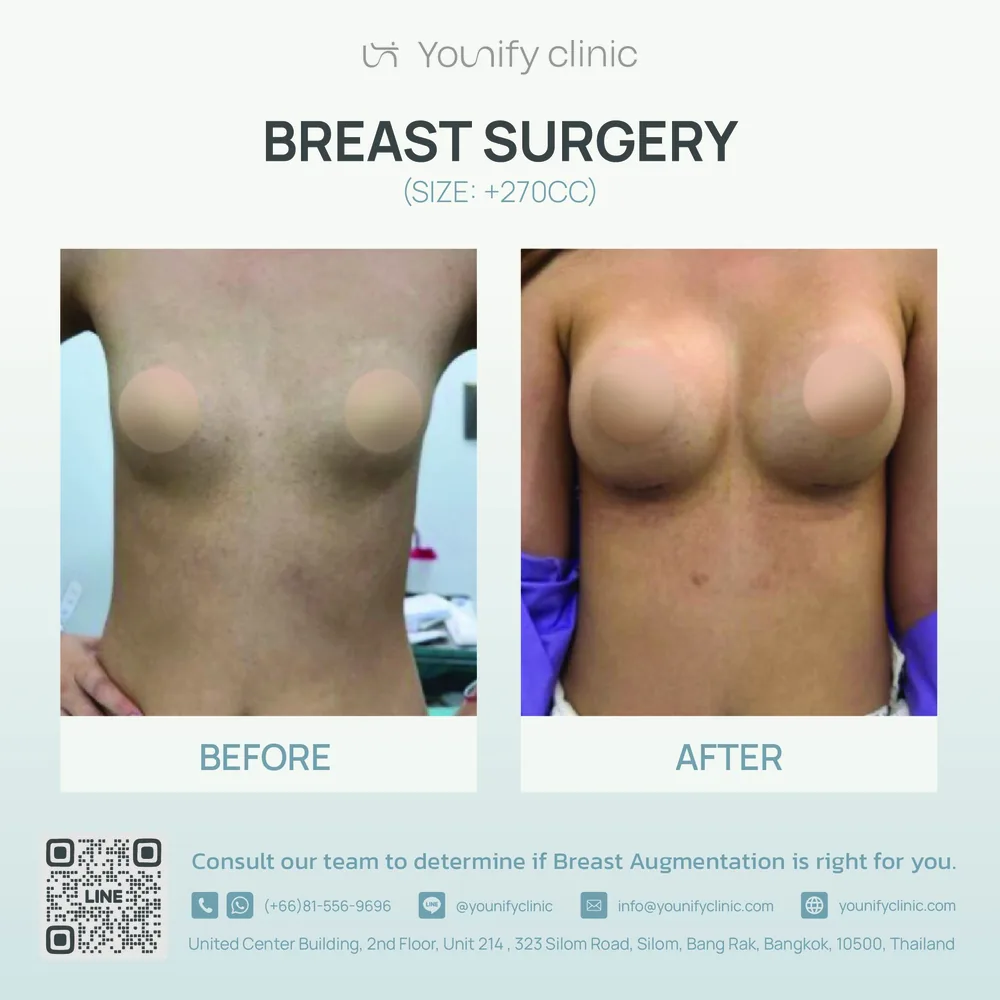
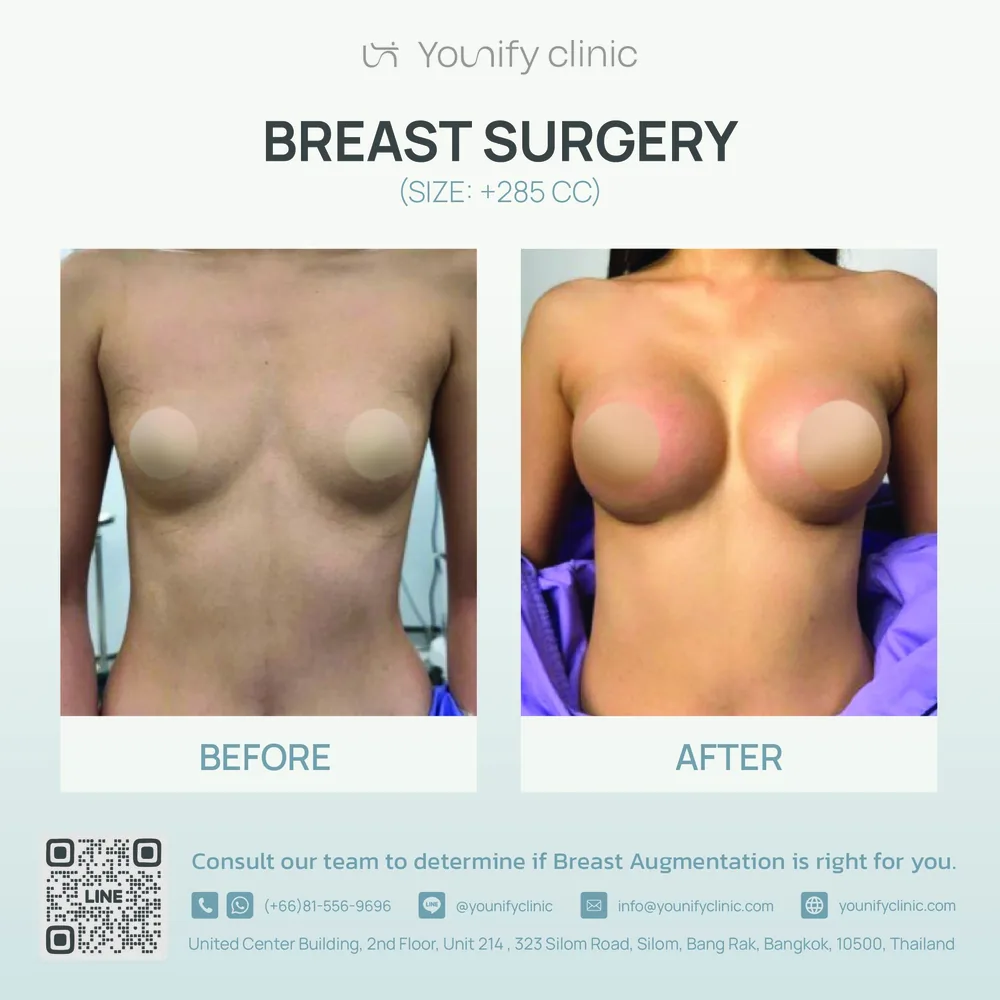
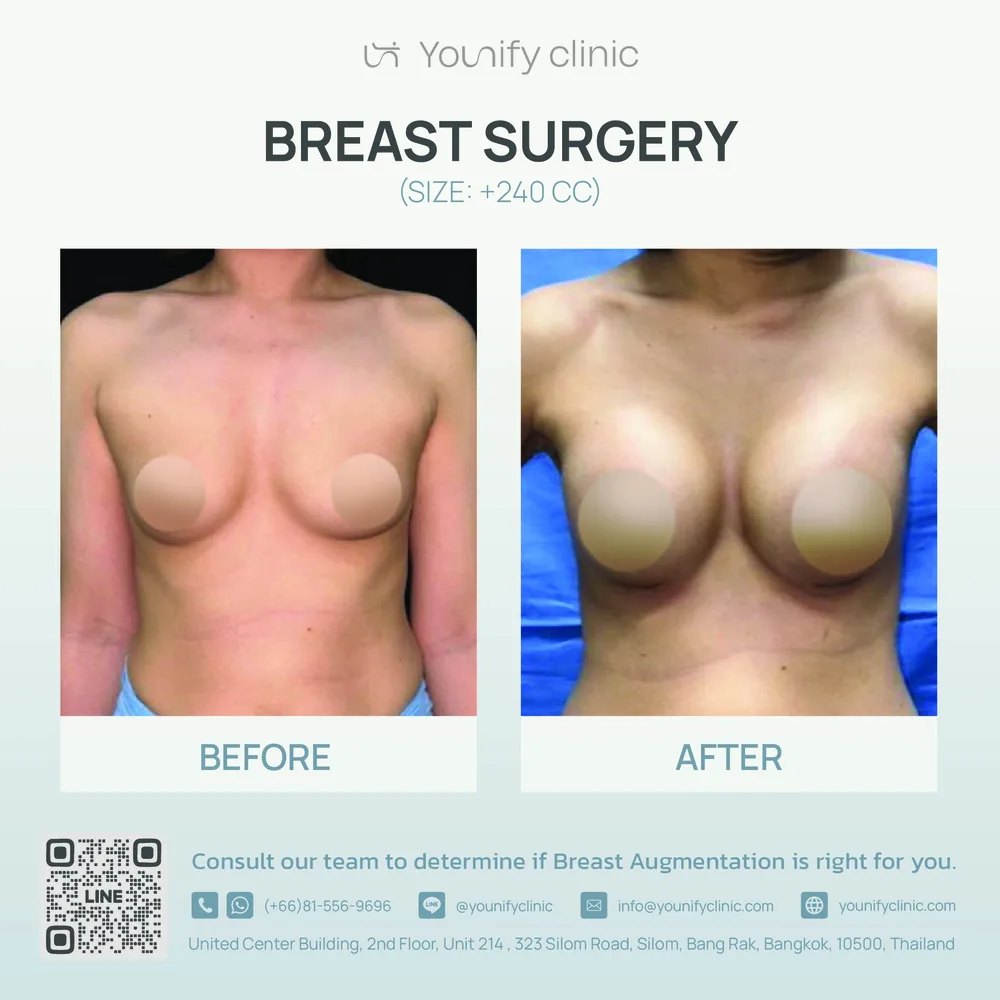
* Real patient results, published with consent. Individual results may vary.
Frequently asked questions
Is the procedure painful?
Some tightness or dull ache is normal at first and is well controlled with prescribed pain relief. Most patients feel much better within a few days.
How long do implants last?
Medical-grade implants are highly durable, but periodic follow-up is recommended to assess them over the long term.
Can I still breastfeed afterward?
Breastfeeding is generally still possible depending on the technique and incision site; your surgeon will discuss this before planning.
Will there be a visible scar?
Incisions are small and placed in discreet locations such as under the breast fold. Once healed, scars fade and become hard to notice.
How long do I need to stay in Bangkok, and when can I fly home?
Most international patients plan 7 to 10 days in Bangkok. Your surgeon checks the sutures around days 7 to 10 and confirms that you are ready to travel.
When can I fly after breast augmentation?
Most international patients fly home within 7 to 10 days, after a suture check and surgeon review. Clearance depends on the incisions, the swelling, and how the implants are sitting, not on the calendar alone.
What is included in the price?
The starting price typically covers the surgeon fee, general anesthesia by an anesthesiologist, the operating room at a JCI- or AACI-accredited partner private hospital in Bangkok, standard implants where applicable, a support bra, and follow-up visits during your stay. Flights, hotel, extra nights, medications after discharge, and revision surgery are typically not included.
How does follow-up work after cosmetic surgery abroad?
At YOUNIFY Clinic it runs on scheduled online reviews with your surgeon, typically at weeks 2 to 3, month 3, month 6, and month 12, each preceded by standardized photographs sent via LINE or WhatsApp. Your family doctor is involved when an in-person check is needed, and we write to them with a summary.
What is an implant card, and why should I keep it?
If you have implants, keep the implant card you were given with your medical records. It lists the type and size of each implant, and any doctor who examines you in future will ask for it.
* This information is for general education. Results and treatment plans depend on an individual medical assessment.
Related procedures
Interested in breast augmentation?
Book a consultation for a personalized assessment and treatment plan with the YOUNIFY Clinic medical team.
Medically reviewed by Dr. Noppachai Siranart · Last reviewed
Surgery is performed by the clinic's two board-certified plastic surgeons at JCI- or AACI-accredited partner private hospitals in Bangkok.
Individual results may vary. Please consult a doctor before treatment.