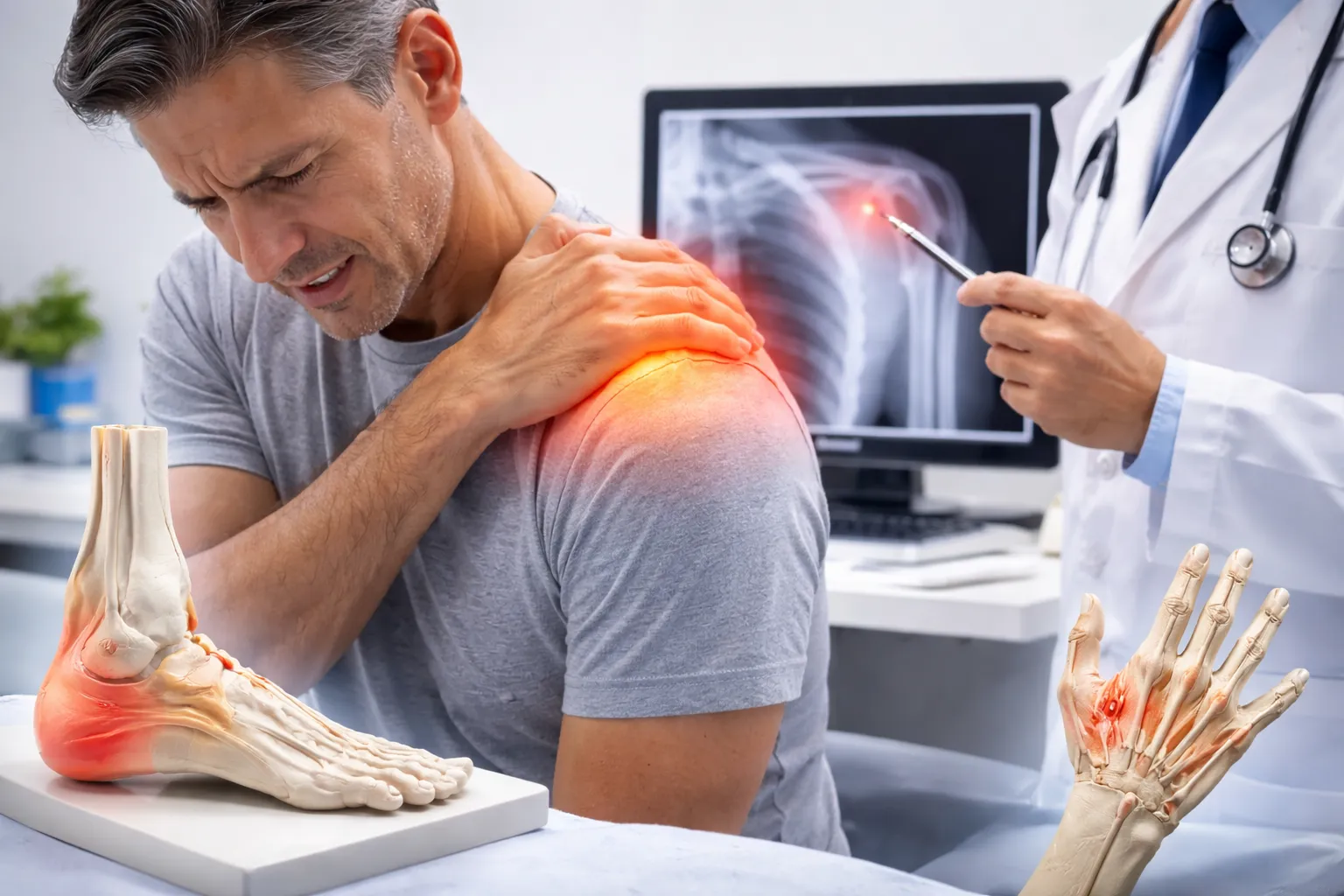
Pain medicine is the medical subspecialty that diagnoses and manages pain itself, especially pain lasting beyond about three months. At YOUNIFY Clinic, a Healthy Aging & Wellness Center based in Bangkok, Thailand, our pain medicine physician at the Silom clinic looks for the pain source, reviews medication, performs image-guided procedures, and coordinates rehabilitation, which may help many people move more comfortably.
Draft awaiting physician review and approval. Not yet published.
Contents
Key Takeaways
- Pain medicine is a medical subspecialty that finds where pain comes from and manages it. In Thailand, physicians can complete subspecialty training in pain medicine after their main specialty.
- Chronic pain is pain that persists or recurs for longer than 3 months, according to the International Association for the Study of Pain.
- At YOUNIFY Clinic, the pain medicine physician performs nerve and spine procedures, and the interventional radiologist performs embolization for selected joint and tendon pain.
What is pain medicine?
Pain medicine is a branch of medicine that treats persistent pain as a clinical problem in its own right, using diagnosis, medication, image-guided procedures, and rehabilitation.
Physicians enter the field from a base specialty. In Thailand, physicians can complete subspecialty training in pain medicine after their main specialty. In practice, the work follows four steps:
1. Diagnose the source from the history, examination, and imaging, because an abnormal scan is not always the cause of pain.
2. Review medication, keeping what helps and reducing what carries long-term risk.
3. Perform image-guided procedures when they fit, such as a diagnostic nerve block or radiofrequency ablation. Most patients go home the same day.
4. Coordinate rehabilitation, because a procedure is designed to make exercise and daily activity easier, not to replace them.
For the procedures themselves, see our guide to interventional pain management.
What counts as acute pain and chronic pain?
Acute pain follows an injury, operation, or illness and usually settles as tissues heal. Chronic pain persists or recurs for longer than 3 months, according to the International Association for the Study of Pain (IASP).
Over time, nerves can become more sensitive, so pain may outlast healing. Guidance from the National Institute for Health and Care Excellence (NICE) separates chronic secondary pain, linked to a condition such as arthritis, from chronic primary pain, which has no clear underlying cause. The two are managed differently.
Pain physician vs orthopedic surgeon, rehabilitation, and neurology: who does what?
An orthopedic surgeon asks whether a structure needs repair; the pain physician asks a different question: which structure or nerve is producing the pain, and how can that signal be reduced without surgery?
| Role | Main focus | Typical tools | When to see them |
|---|---|---|---|
| Pain medicine physician | The source of persistent pain | Diagnostic nerve blocks, image-guided injections, radiofrequency procedures, medication review | Pain beyond about 3 months, or pain not settling with initial care |
| Orthopedic surgeon | Bones, joints, and tendons that may need repair | Imaging, fracture care, joint and spine surgery | A fracture, a joint that locks or gives way, or a problem that may need an operation |
| Rehabilitation physician or physiotherapist | Movement, strength, and function | Exercise programs, manual therapy, activity adjustments | Most back, neck, and joint pain early on, and alongside any procedure |
| Neurologist | Diseases of the brain, spinal cord, and nerves | Neurological examination, nerve conduction studies, medication | Headache patterns, numbness, weakness, or suspected nerve disease |
The roles overlap, and each doctor refers to the others when needed.
When should you see a pain medicine doctor?
Consider a pain medicine doctor when pain has lasted about three months or keeps returning despite rest, medication, and physiotherapy. Common reasons include:
- persistent neck or back pain, with or without pain spreading into a limb
- a wish to understand non-surgical options before, or instead of, surgery
- pain that remains after spine or joint surgery, or nerve pain after shingles
If you are looking for a chronic pain doctor in Bangkok, our guide on how to choose a pain clinic may help.
How do the pain physician and the interventional radiologist work together at YOUNIFY Clinic?
At YOUNIFY Clinic, our pain medicine physician performs nerve and spine procedures, while our interventional radiologist performs embolization for selected joint and tendon pain. Complex cases are reviewed together.
Embolization works on blood flow rather than on a nerve: through a small puncture, a thin catheter is designed to reduce abnormal blood flow thought to feed inflammation around a joint or tendon. Examples are Genicular Artery Embolization (GAE) for knee osteoarthritis and Transarterial Microembolization (TAME) for frozen shoulder, tennis or golfer elbow, and plantar fasciitis. The Society of Interventional Radiology describes GAE for people who have not improved with conservative care. Evidence for TAME is still developing, and suitability is decided by our interventional radiologist after assessment.
As a guide, procedures range from dry needling, starting from THB 650, to epidural balloon neuroplasty, starting from THB 170,000. The full list is on the chronic pain service page.
When to see a doctor urgently
Go to an emergency department, not a clinic appointment, if pain comes with:
- new or worsening weakness in an arm or leg
- loss of bladder or bowel control
- numbness in the saddle area, between the legs
- fever with back pain
- severe pain after a major fall or accident
- unexplained weight loss
When we may advise against a procedure
Our physicians may advise against a procedure, or delay it, when:
- blood thinners have not yet been safely managed with the prescribing doctor
- there is an active infection, in the body or at the skin where the needle would go
- the patient is pregnant, for any procedure that uses X-ray guidance
- diabetes is not well controlled, for procedures that use a corticosteroid
- the pain source has not been confirmed
- the expectations are ones the procedure cannot meet
We explain why and suggest what can be done instead.
Physician perspective
[รอ approve] At our clinic, the first visit starts with what you want to get back to: sleeping through the night, walking to the BTS station, or sitting through a meeting. That goal shapes the plan more than the MRI does. We then work out whether the pain comes from a nerve, a joint or a tendon, and we review your medicines from the first visit, because some people take more than they need. When the source is unclear, we choose a small diagnostic block before a bigger step. When a joint or tendon problem may suit embolization, we plan it together with the interventional radiologist. If rehabilitation alone is the right answer, we say so.
An illustrative example
Illustrative example, not a real patient: an office worker has had low back pain for five months. A surgical review found no need for an operation, and physiotherapy helped only in part. Our pain medicine physician reviews the MRI and examination, suspects the small facet joints of the spine, and suggests a diagnostic medial branch block before any further step. Physiotherapy continues alongside, and the plan is reviewed after the block.
What happens next
1. Send an X-ray or MRI report and a short history of your pain.
2. Our pain medicine physician reviews them, with our interventional radiologist where relevant.
3. You receive a written plan and a written quotation.
4. If a procedure is suitable, it is scheduled, and most patients go home the same day.
5. Follow-up checks how pain and daily function have changed.
We are at 2nd Floor, Room 214, United Center Building, 323 Silom Road, Silom, Bang Rak, Bangkok 10500, Thailand, a five-minute walk from BTS Sala Daeng, open every day from 11:00 to 20:00 Bangkok time.
To start, send your X-ray or MRI report and a short history for a physician review by WhatsApp +66 81 556 9696 or LINE.
Frequently Asked Questions
Is a pain medicine doctor the same as an anesthesiologist?
Not exactly. Many pain medicine physicians train in anesthesiology before entering the field, because it builds skill with nerve blocks, but pain medicine is a separate subspecialty with its own training and board certificate. You can check any physician's registration with the Medical Council of Thailand: checkmd.tmc.or.th.
Should I see an orthopedic surgeon or a pain physician for back pain?
If there is a fracture, a clear structural problem, or nerve compression causing weakness, a surgical opinion matters. For most persistent back pain without these features, a pain physician can look for the pain source and discuss non-surgical options. The two often work together.
Will a pain physician just give me an injection?
No. Many plans involve no procedure, or a procedure only after the pain source is confirmed. The physician begins with your history, examination, imaging, and current medication. When a procedure is offered, it is meant to help you take part in rehabilitation, which usually remains part of the plan.
Do I need a referral to see a pain medicine physician at YOUNIFY Clinic?
A referral letter is not required. It helps to send previous imaging reports, a list of current medication, and notes from other doctors you have seen. With your permission, we can send our assessment to a doctor who is already treating you.
How much does pain medicine treatment cost, and does insurance cover it?
Starting prices for each procedure are listed on the chronic pain service page. The consultation fee is confirmed when you book, and imaging is quoted after a physician assessment. You receive a written quotation before any procedure. We prepare a medical report and itemized receipts for your own insurance claim.
Can a pain physician help if I still have pain after surgery?
Sometimes. The physician checks whether the pain comes from scar tissue, a nerve, a nearby joint, or a new problem, then discusses medication, rehabilitation, or procedures such as epidural balloon neuroplasty. Relief varies and does not last for everyone.
References
- Definitions of Chronic Pain Syndromes. International Association for the Study of Pain (IASP).
- Treede RD, Rief W, Barke A, et al. Chronic pain as a symptom or a disease: the IASP Classification of Chronic Pain for the International Classification of Diseases (ICD-11). Pain, 2019;160(1):19-27.
- Chronic pain (primary and secondary) in over 16s (NG193). National Institute for Health and Care Excellence (NICE), 2021, ผ่าน NCBI Bookshelf.
- New position statement highlights the growing role of genicular artery embolization for knee osteoarthritis. Society of Interventional Radiology (SIR), 12 พ.ค. 2026.
Medical Note
This article is for general information and does not replace medical examination, diagnosis, or treatment. If symptoms are severe, changing quickly, or urgent, seek medical care promptly.
Individual results may vary. Please consult a doctor before treatment.
Want to know which care plan fits you?
Share your symptoms, health history, medications or prior procedures, and personal goals. Our team can help arrange a medical assessment.
Consult YOUNIFY Clinic