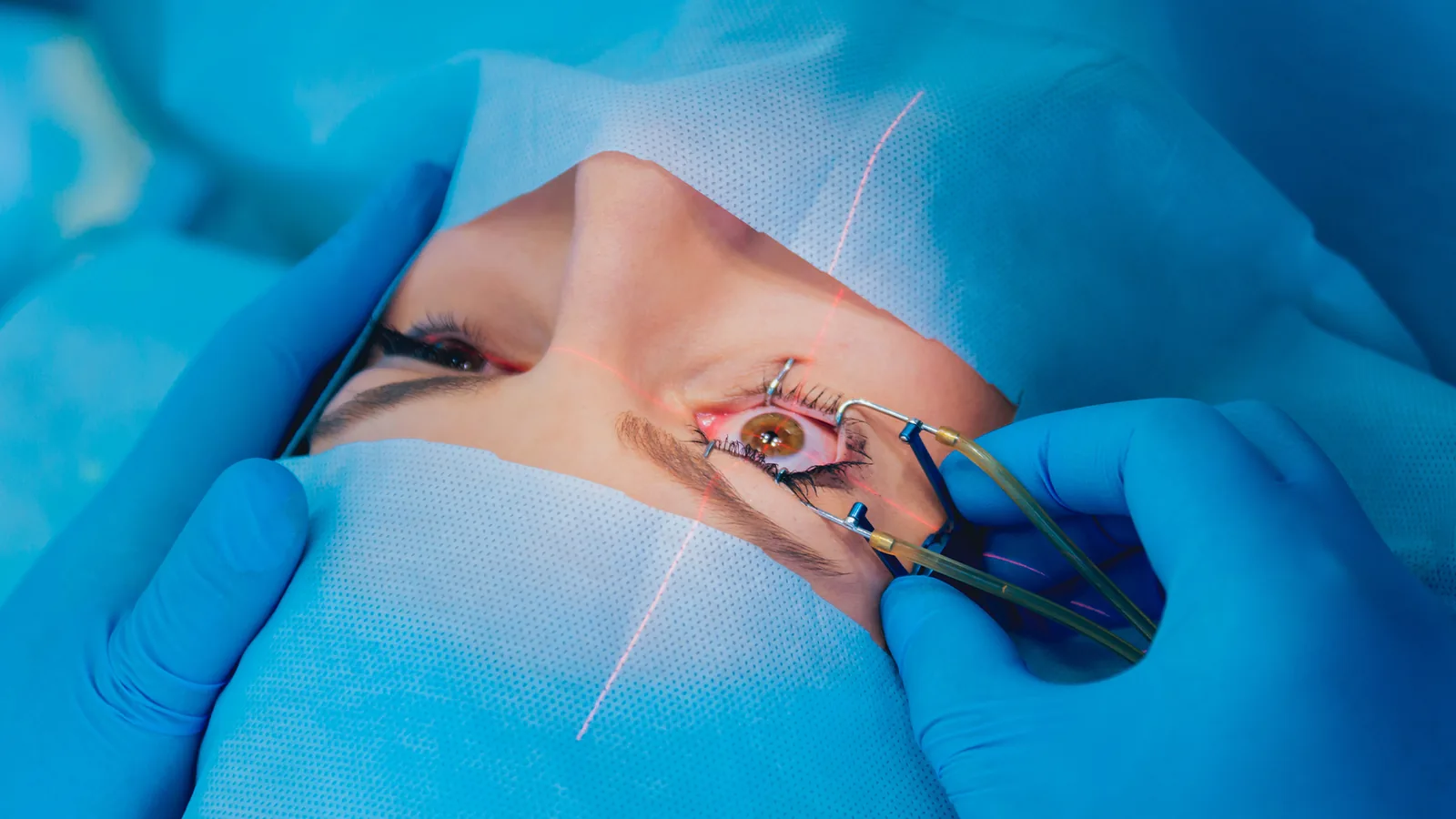
ReLEx SMILE vs LASIK in Bangkok: how the incision, dry-eye risk, recovery and prescription range differ, and how to decide sensibly before you travel for surgery.
Contents
Key Takeaways
- Both procedures reshape the cornea with a laser; they differ in how the laser reaches the corneal tissue.
- FemtoLASIK lifts and replaces a corneal flap; ReLEx SMILE removes a lenticule through an incision a few millimetres wide.
- Five differences matter in practice: incision and corneal structure, dry eye, how quickly vision settles, prescription range, and future enhancement.
- Starting prices for both eyes: FemtoLASIK from THB 69,000 · ReLEx SMILE quoted after assessment.
- Screening decides the answer, so avoid committing to one technique before you have been measured. Results vary from person to person.
The one-sentence difference between ReLEx SMILE and LASIK
Both use a laser to reshape the cornea. What differs is the route in — and that single difference drives the incision, how recovery feels, how likely dry eye is, and which prescriptions can be treated. LASIK, today usually performed as FemtoLASIK, lifts a thin corneal flap, reshapes the tissue underneath and lays the flap back down. ReLEx SMILE shapes a thin lenticule of tissue inside the cornea and draws it out through an incision only a few millimetres wide, with no large flap.
This article was prepared by the YOUNIFY Clinic medical team for readers who are deciding before they travel. We do not argue for one technique over the other, because the correct answer for your eyes comes out of your measurements, not out of an article.
Side-by-side comparison
Both are widely used, well-documented options. Choosing between them is a question of fit with your cornea and your lifestyle, not a question of one being superior.
| Point of comparison | ReLEx SMILE | FemtoLASIK |
|---|---|---|
| Incision | A few millimetres at the edge; no large corneal flap is lifted | A corneal flap is lifted and repositioned |
| Lasers used | A single laser throughout | One laser to create the flap plus an excimer laser to reshape |
| Disturbance to the corneal surface and its nerves | Comparatively less | Comparatively more |
| Dry eye after surgery | Usually milder and resolves sooner | Common in the first months, usually improving gradually |
| How quickly vision settles | Most patients within 1–2 days; some take slightly longer to adapt | Most patients within 1–2 days |
| Prescriptions treated | Mainly myopia and astigmatism within a defined range | Myopia, astigmatism and hyperopia within suitable ranges |
| Flap and impact to the eye | No large flap to be concerned about | Impact to the eye must be avoided, especially early on |
| Future enhancement | Possible, but the approach needs planning with your ophthalmologist | A familiar and often more straightforward pathway |
| From (both eyes) | quoted after assessment | from THB 69,000 |
Prices shown are market starting prices for orientation. Service details: ReLEx SMILE and LASIK and FemtoLASIK.
Five differences that actually affect your experience
Incision and corneal structure. FemtoLASIK needs a reasonably large flap so the laser can work underneath. ReLEx SMILE uses a small incision as the channel through which the lenticule is removed, so most of the corneal surface stays continuous, which in theory disturbs the structural strength of the cornea less. This is why people who play contact sport, or whose work carries a risk of blows to the eye, are often steered towards ReLEx SMILE or PRK first.
Dry eye. Post-operative dryness happens because the fine nerves in the corneal surface are disturbed and temporarily signal less tear production. A smaller incision disturbs fewer of those nerves, so many ReLEx SMILE patients report milder dryness that settles sooner. Both techniques can cause dry eye during recovery, it usually improves with time, and the degree varies between individuals — particularly in people who already had dry eye beforehand.
How quickly vision settles. Both are fast-recovery procedures and most patients see more clearly within 1–2 days. The difference people notice is that FemtoLASIK often feels slightly quicker on day one, while some ReLEx SMILE patients need a few more days to adapt. Recovery time varies from person to person.
Prescription range. FemtoLASIK covers a wider range, including hyperopia within suitable limits. ReLEx SMILE is strongest for myopia and astigmatism within a defined range and is generally not used for hyperopia. For some people, therefore, there is no real choice to make: the prescription has already narrowed it down.
Future enhancement. Prescriptions can change over the years and a small number of people consider further treatment later. After FemtoLASIK the familiar route is to lift the original flap. After ReLEx SMILE there is no original flap, so an enhancement has to be planned differently — it can be done, but it is worth discussing before your first decision, not after it.
We deliberately do not publish diopter cut-offs for either technique, because the ranges applied in practice follow your full set of measurements and your ophthalmologist's judgement.
Dry eye after laser eye surgery — what to expect
Dry eye is the single most common complaint in the weeks after refractive surgery, and it is also the one most affected by travel: long-haul flights, air conditioning and screen work all reduce tear-film stability at exactly the wrong moment.
Practical expectations: use artificial tears on the schedule you are given rather than only when your eyes feel dry; assume you will need them on the flight home; and tell the screening team if you already use drops, wear lenses that feel gritty by the evening, or have had eyelid inflammation. If you have a pre-existing dry-eye problem, treating it before surgery is part of the preparation, not an optional extra.
If dryness or grittiness persists beyond the expected adjustment period, that is a reason to be examined rather than to buy stronger drops. Background reading: dry eye and screen-related eye strain.
Who suits SMILE, who suits FemtoLASIK, who suits neither
The selection principle is that the measurements decide, not personal preference — corneal thickness and shape, prescription, and tear-film quality determine which technique is safer and more predictable for that particular pair of eyes.
- ReLEx SMILE is often considered for: myopia and/or astigmatism within the range it covers; a tendency to dry eye or discomfort with contact lenses; contact sport or work with a risk of blows to the eye; a preference for less disturbance to the corneal surface.
- FemtoLASIK is often considered for: hyperopia or prescription patterns ReLEx SMILE does not cover; wanting vision to settle quickly in the first days; a likelihood of needing enhancement later; budget as one factor alongside clinical suitability.
- Neither is appropriate yet, or needs particularly careful assessment, if: the cornea is thinner than accepted limits or irregular and bulging; the prescription has continued changing over the past year; there is severe dry eye or uncontrolled eyelid inflammation; you are pregnant or breastfeeding; or there is corneal or retinal disease, or a condition affecting wound healing.
If neither laser option suits because the cornea is thin or the prescription very high, the usual next option is an implanted lens inside the eye — see high myopia and thin corneas.
What happens if screening says you need a different procedure
This is the scenario international patients worry about most, and it is worth settling before you book. Screening quite often changes the plan: a cornea slightly thinner than expected, an irregular topography, or a tear film that needs treating first.
If that happens, our ophthalmologist explains what the scans show, sets out which techniques do suit your eyes, and — if the obstacle is temporary — advises when it is reasonable to be reassessed. Ask any provider, before you pay a deposit, what their terms are if screening rules out the procedure you booked. A clinic that has a clear answer to that question is telling you something useful about how it works.
Your visit in Bangkok, day by day
The pathway is almost identical for both techniques; only the step inside the operating theatre differs. Screening takes the most time and decides everything else.
- Screening — refraction, corneal thickness, corneal topography, intraocular pressure, tear-film assessment and a dilated retinal examination. Contact lens wear must stop beforehand for the period the medical team specifies, since lenses temporarily change corneal shape.
- Discussing results and choosing together — our ophthalmologist shows you the actual images and numbers, what limits your eyes impose, what can realistically be expected, and the risks specific to you.
- Procedure day — anaesthetic eye drops, awake throughout, a short time per eye, brief observation afterwards, and in the usual case you leave the same day with a companion.
- Follow-up — scheduled reviews of healing, clarity, intraocular pressure and dryness. Arrange at least one review before you fly home.
Screening and follow-up take place at the YOUNIFY clinic on Silom Road, a short walk from BTS Sala Daeng. The procedure itself is performed by our own medical team at an affiliated hospital with an appropriately equipped operating theatre.
Preparation and aftercare, including your flight home
Aftercare is nearly the same for both techniques: use every drop on schedule, do not rub your eyes, and avoid anything that risks infection or impact while healing. The difference is that FemtoLASIK patients need to protect the flap from impact for longer.
- Before: stop contact lens wear as instructed (rigid lenses for longer than soft), skip eye make-up and perfume on the day, report any redness, irritation or illness beforehand, and arrange a companion and sunglasses.
- After: use the anti-inflammatory drops, the antibiotic drops and artificial tears exactly as scheduled — each does a different job.
- Do not rub your eyes in the early period and wear the night shield as instructed.
- No water in the eyes: avoid swimming, sauna and eye make-up for the period advised; FemtoLASIK patients should avoid contact sport for longer, per individual advice.
- Severe pain, increasing redness or clearly worsening vision means contacting us or an eye doctor immediately rather than waiting for the next scheduled review.
For the flight, keep all drops in your hand luggage, use artificial tears more often than you think you need to in the dry cabin air, and take an operative summary plus your measurements so an ophthalmologist at home can review you. Also see how the two techniques compare on cost in LASIK cost in Thailand 2026.
If you cannot decide, let the measurements decide for you: book a screening, and see ReLEx SMILE at YOUNIFY or message us on LINE @younifyclinic or WhatsApp to arrange your assessment in Silom.
Frequently Asked Questions
What is the shortest possible answer to ReLEx SMILE vs LASIK?
LASIK lifts a corneal flap and replaces it; ReLEx SMILE removes a lenticule of tissue through a small incision without lifting a large flap. That difference affects the incision, the likelihood of dry eye and how careful you need to be about blows to the eye.
Is dry eye really less of a problem with ReLEx SMILE?
Comparatively, ReLEx SMILE disturbs the corneal surface nerves less, and many patients report milder dryness that settles sooner. Both techniques can cause dry eye during recovery, and the degree varies between individuals.
Can ReLEx SMILE treat hyperopia?
Generally it is not used for hyperopia, so patients with that prescription pattern are usually advised to consider other options. As always, this must be assessed on your actual measurements.
If my prescription changes years after ReLEx SMILE, can it be corrected?
Further treatment is possible, but the approach differs from LASIK because there is no original flap to lift. Discuss the long-term plan with your ophthalmologist before your first procedure rather than afterwards.
Which one hurts more?
Both are done under anaesthetic eye drops. Most patients describe pressure or a dull sensation during the procedure rather than pain, with irritation and watering in the first hours afterwards that usually settles.
I am flying in and cannot decide. Where should I start?
Start with screening. Corneal thickness, corneal shape and your true prescription usually narrow the options considerably on their own, and the decision is then made together with the ophthalmologist rather than in advance from a website.
References
- Cochrane Database of Systematic Reviews — Small incision lenticule extraction (SMILE) versus LASIK for myopia
- American Academy of Ophthalmology — LASIK: Laser Eye Surgery
- American Academy of Ophthalmology — What Is Dry Eye?
- NICE Interventional Procedures Guidance IPG164 — Photorefractive (laser) surgery for the correction of refractive errors
Clinic open daily, 11:00 to 20:00 (Bangkok time) · Online enquiries answered 24 hours a day
Medical Note
This article is for general information and does not replace medical examination, diagnosis, or treatment. If symptoms are severe, changing quickly, or urgent, seek medical care promptly.
Individual results may vary. Please consult a doctor before treatment.
Want to know which care plan fits you?
Share your symptoms, health history, medications or prior procedures, and personal goals. Our team can help arrange a medical assessment.
Consult YOUNIFY Clinic