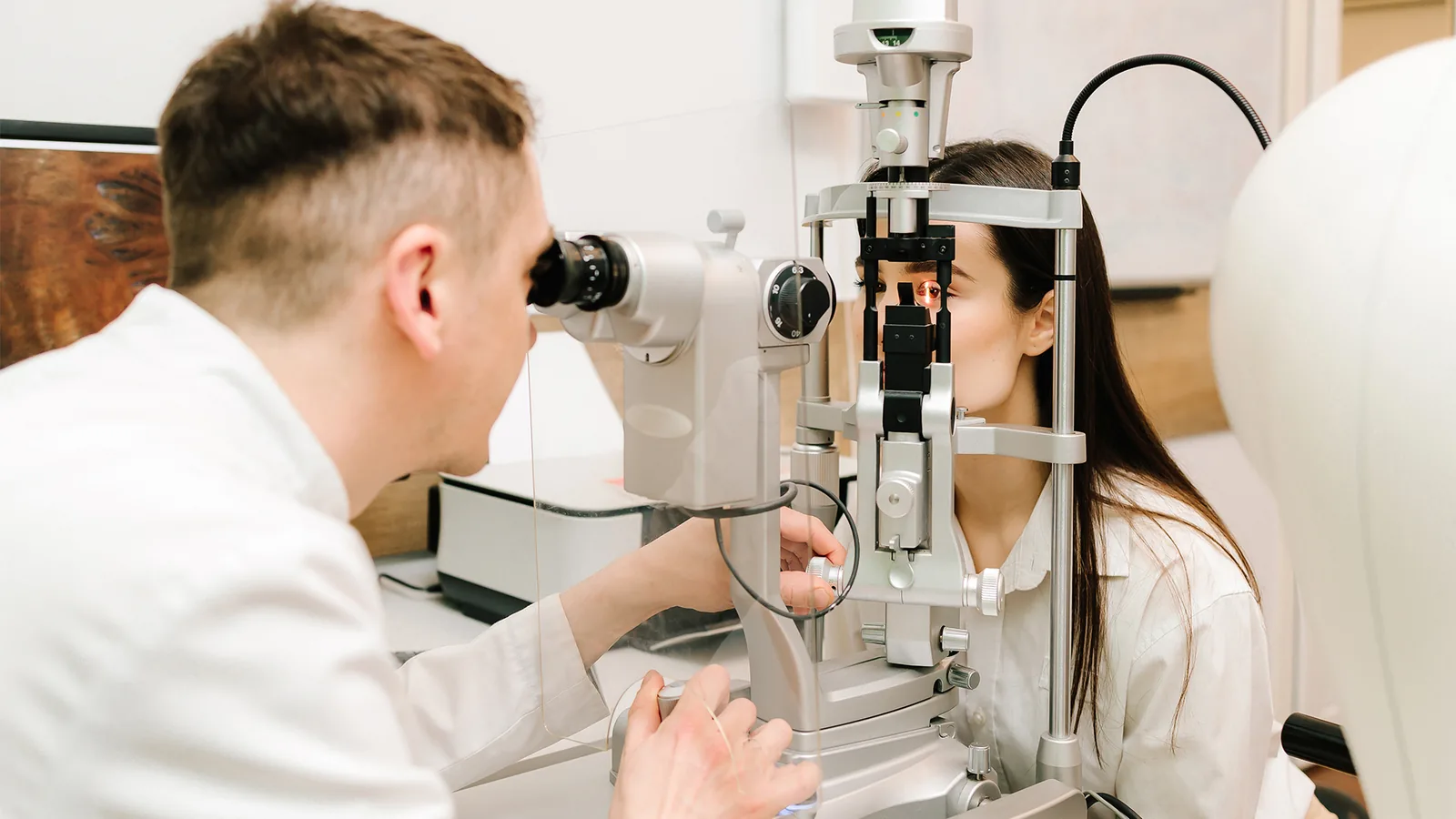
What LASIK, ReLEx SMILE and ICL actually cost in Bangkok in 2026, what a Thai package usually includes, and how to choose the right procedure before you book a flight.
Contents
Key Takeaways
- Thai market starting prices in 2026, both eyes: PRK from THB 42,500 · FemtoLASIK from THB 69,000 · ReLEx SMILE and ICL quoted after assessment.
- The number that matters is not the headline price but what the package covers: screening, eye drops, and how many follow-up visits.
- Which procedure suits you is decided by corneal thickness, corneal shape and tear-film quality, not by budget.
- If you are travelling, plan your trip around the screening day, the procedure day and at least one early follow-up before you fly home.
- Results and recovery vary from person to person, and some travellers are advised to postpone.
What laser vision correction costs in Bangkok in 2026
If you are comparing eye surgery across countries, price is usually the first filter. It is also the least useful one on its own. Laser vision correction is not a single product with different price tags: each technique reaches the cornea in a different way, each has its own limits, and each suits a different kind of eye. This article, prepared by the YOUNIFY Clinic medical team, sets out how pricing is structured in Thailand in 2026 and what an international patient should check before booking anything.
In the Thai market in 2026, prices for both eyes start at around THB 42,500 for PRK and THB 69,000 for FemtoLASIK; ReLEx SMILE is quoted after assessment. ICL, which places an additional lens inside the eye rather than reshaping the cornea, is quoted after assessment. Your own figure depends on your screening results and on what the package includes.
All prices below are quoted in Thai baht as starting prices for both eyes, unless stated otherwise. We do not publish a fixed foreign-currency equivalent because exchange rates and card fees move; check the current rate with your own bank before you compare.
| Procedure | From (both eyes) | How it works | Typical recovery | Often considered when |
|---|---|---|---|---|
| PRK | from THB 42,500 | The outer surface layer of the cornea is removed and the laser reshapes the corneal surface directly. No corneal flap is created. | More irritation in the first days; vision sharpens gradually over several weeks. | The cornea is relatively thin, or the patient's work or sport carries a risk of blows to the eye. |
| FemtoLASIK | from THB 69,000 | A laser, rather than a blade, creates a thin corneal flap; a second laser reshapes the tissue underneath before the flap is replaced. | Most patients see more clearly within 1–2 days. | Myopia, astigmatism or hyperopia within the suitable range, with sufficient corneal thickness. |
| ReLEx SMILE | quoted after assessment | A single laser shapes a thin disc of tissue inside the cornea, which is removed through an incision a few millimetres wide. No large flap is lifted. | Most patients recover quickly and see more clearly within 1–2 days. | A preference for less disturbance to the corneal surface, or a tendency towards dry eye. |
| ICL | quoted after assessment | A thin lens is implanted inside the eye. No corneal tissue is removed, and the lens can be explanted later if indicated. | Most patients see more clearly within 1–2 days, but long-term monitoring is required. | High myopia, thin corneas, or other findings that make laser treatment unsuitable. |
These are market starting prices for orientation, not a personal quotation.
What a Thai package usually includes — and what it does not
The advertised price is often just the procedure fee. The real cost of refractive surgery is made up of several parts: the pre-operative assessment, the operating room and laser platform, the medical and nursing team, single-use consumables, post-operative eye drops, and the follow-up schedule. Anything missing from the headline number is something you may be asked to pay for later.
Before you compare two clinics, confirm in writing whether each of the following is included:
- A full pre-operative assessment — refraction with and without dilating drops, corneal thickness measurement (pachymetry), corneal curvature mapping (topography), intraocular pressure, a dilated retinal examination and a tear-film assessment.
- Operating room and laser platform time — the largest fixed cost in this group of procedures. YOUNIFY uses techniques and equipment that meet recognised international standards.
- The medical and multidisciplinary team — the ophthalmologist performing the procedure, operating-room nurses and the coordinators who look after you throughout.
- Specialised consumables and, for ICL, the lens itself, which is ordered individually for your prescription and eye dimensions.
- Post-operative eye drops and medication — included by some providers, billed separately by others.
- Scheduled follow-up visits — ask how many are covered and over what period, which matters a great deal if you are flying home.
Five questions worth asking every provider you shortlist: Does this price include the entire pre-operative assessment? How many follow-up visits and which medications are covered? What happens if screening shows the procedure I booked is not suitable for me? What are the terms if my prescription changes and further treatment is considered later? Who performs the assessment, and who performs the procedure?
PRK, FemtoLASIK, ReLEx SMILE and ICL in one minute each
All four aim to reduce your dependence on glasses and contact lenses, but they act on different parts of the eye. The first three reshape the cornea; ICL adds a lens inside the eye without removing corneal tissue. That difference explains both the price gap and the different indications.
PRK removes the outer surface cells of the cornea and reshapes the surface directly with the laser. Because no flap is created, there is no flap to be displaced by a blow to the eye, and in some cases less corneal tissue is used. The trade-off is a more uncomfortable first few days, a bandage contact lens while the surface heals, and vision that sharpens gradually over several weeks.
FemtoLASIK uses a high-speed laser instead of a blade to create a thin corneal flap, then a second laser reshapes the tissue underneath before the flap is repositioned. Recovery is comfortable, most patients see more clearly within 1–2 days, and it covers a wide range of prescriptions. The flap needs protecting from impact in the early period, and temporary dry eye is common in the first months. See LASIK and FemtoLASIK.
ReLEx SMILE uses one laser to shape a thin lenticule of tissue inside the cornea and removes it through an incision only a few millimetres wide, without lifting a large flap. It disturbs the corneal surface and the surface nerves comparatively less, which is why it is often chosen by people concerned about dry eye or with an active outdoor life. Its prescription range is narrower than some alternatives, and any future enhancement needs to be planned with your ophthalmologist. See ReLEx SMILE.
ICL implants a thin lens inside the eye through a small incision, without removing corneal tissue. It is the option usually considered when the prescription is very high or the cornea is too thin for laser treatment, and the lens can be removed later if indicated. The higher price reflects the individually ordered lens plus a more detailed assessment and follow-up. See ICL.
If your shortlist has come down to the two laser options, the detailed comparison is in ReLEx SMILE vs LASIK.
How many days you need to stay in Bangkok
This is the question that decides your flights, and it is also the one where a generic answer online can cost you money. The honest version is that your itinerary is built around three fixed points: a screening day, a procedure day, and at least one early follow-up before you fly.
Screening cannot be compressed. It takes a long appointment, and you must stop wearing contact lenses beforehand for a period your medical team will specify — longer for rigid lenses than for soft ones. Because contact lenses temporarily change the shape of the cornea, arriving straight from a long-haul flight still wearing lenses is the most common reason an international patient's measurements have to be repeated.
The procedure itself is short, done under anaesthetic eye drops, and you go home the same day in the usual case, with someone to accompany you. What varies is the follow-up interval, which depends on the technique chosen and on how your eyes respond. Surface treatments such as PRK take longer to settle than flap or lenticule techniques.
We do not publish a fixed number of nights, because the safe answer depends on your screening results and on whether both eyes are treated in the same trip. Ask us to confirm the plan for your case before you buy non-refundable tickets, and build in spare days rather than booking a flight the morning after surgery.
Who is a candidate, and who should not fly for surgery
Suitability is decided by measurements, not by the prescription printed on your glasses. Corneal thickness, corneal shape and tear-film quality cannot be judged by eye, which is why the guidance below is only a starting point.
Laser vision correction is often a reasonable option for people who:
- Are 18 or older with a prescription that has been reasonably stable for at least about a year.
- Have generally healthy eyes, with no corneal or retinal disease that would contraindicate treatment.
- Have corneal thickness and shape that the medical team assesses as suitable.
- Understand that the goal is to reduce dependence on glasses, not to commit in advance to any particular level of vision.
It is better to postpone, or to be assessed particularly carefully, if your prescription has continued to change over the past year; if you are pregnant or breastfeeding, since hormonal changes can shift both prescription and tear film; if you have severe dry eye or uncontrolled eyelid inflammation; if screening finds an unusually thin cornea or an irregular, bulging corneal shape; or if you have a condition or medication that affects wound healing or immunity.
We deliberately do not publish numeric cut-offs for corneal thickness or prescription range, because the criteria applied in practice depend on the full set of measurements and on the ophthalmologist's judgement for your eyes. If laser treatment is ruled out, the usual next option is an implanted lens — see high myopia and thin corneas.
Your visit, step by step
For international patients the pathway has four stages, and the screening stage is the one that decides everything else.
- Screening — a long appointment covering refraction, corneal thickness and curvature mapping, intraocular pressure, tear-film assessment and a dilated retinal examination. Stop wearing contact lenses in advance as instructed; your pupils will be dilated, so do not plan to drive or to sightsee in bright sun straight afterwards.
- Discussing the results — our ophthalmologist goes through your scans and numbers, explains which techniques suit your eyes and which do not, what can realistically be expected, and the risks specific to you. If your first choice turns out to be unsuitable, this is where the plan changes.
- Procedure day — anaesthetic eye drops, you stay awake throughout, and each eye takes only a short time. You rest under observation briefly and, in the usual case, leave the same day with someone accompanying you.
- Follow-up — scheduled reviews of healing, clarity and intraocular pressure. The intervals depend on the technique and on how your eyes settle.
Screening and all follow-up appointments take place at the YOUNIFY clinic on Silom Road, a short walk from BTS Sala Daeng. The procedure itself is performed by our own medical team at an affiliated hospital with an appropriately equipped operating theatre, so the team that assesses you is the team that treats and reviews you.
Aftercare abroad — what to arrange with your eye doctor at home
Preparation and aftercare are the same for travellers as for local patients, with one addition: someone at home needs to be able to see you if a question arises after you fly.
- Before the procedure: stop contact lens wear as instructed, skip eye make-up, perfume and eye creams on the day, sleep properly, tell the team about any illness or eye infection, arrange a companion and bring sunglasses.
- After the procedure: use every drop exactly on schedule — the anti-inflammatory, the antibiotic and the artificial tears each do a different job.
- Do not rub your eyes in the early period, and wear the protective shield at night as instructed.
- Keep water out of your eyes: no swimming, no sauna and no eye make-up for the period advised.
- Avoid contact sport and dusty environments while healing, and be aware that dry eye, grittiness or halos around lights at night are common during the adjustment period and usually settle. Severe pain, increasing redness or clearly worsening vision means contact us or an eye doctor immediately.
Before you leave Bangkok, ask for a written operative summary and a copy of your pre- and post-operative measurements, and identify an ophthalmologist at home who can review you. Take enough of each drop for the full course, keep them in your hand luggage, and expect screen-based work to feel comfortable again within a few days for flap and lenticule techniques and rather longer after PRK. Results and recovery vary from person to person.
The most useful next step is a screening appointment, not a price list: see what your eyes actually allow, then decide on technique and cost. Read more on LASIK and FemtoLASIK at YOUNIFY, or message us on LINE @younifyclinic or WhatsApp to arrange your assessment in Silom.
Frequently Asked Questions
How much does LASIK cost in Thailand, and why do quotes differ so much?
Starting prices in the Thai market in 2026 are around THB 42,500 for PRK and THB 69,000 for FemtoLASIK; ReLEx SMILE and ICL are quoted after assessment. Differences between providers come from the depth of the pre-operative assessment, the equipment used, the number of follow-up visits and what the package covers.
Are the prices per eye or for both eyes?
The laser and ICL prices quoted here are starting prices for both eyes. Cataract surgery is priced per eye. Whenever you compare quotes from other providers, ask explicitly which basis is being used.
Can I have the screening and the procedure in the same trip?
Often yes, but the plan depends on your screening results, on the technique chosen and on whether both eyes are treated in the same trip. Contact lens wear must stop before screening, and at least one early follow-up should happen before you fly. Confirm your itinerary with us before booking non-refundable tickets.
What happens if screening shows I am not suitable for the procedure I wanted?
It happens regularly, and saying that a procedure is not appropriate is part of proper care. Our ophthalmologist will explain what the measurements show, discuss the alternatives that do suit your eyes, and if the issue is temporary, advise when it is reasonable to be reassessed.
Will I still need glasses afterwards?
The aim is to reduce day-to-day dependence on glasses. Most patients find daily life considerably easier, but everyone develops age-related difficulty with near focus over time and may need reading glasses. Results vary from person to person.
Who looks after me once I am back home?
You should leave with an operative summary and your measurements, and you should identify an ophthalmologist in your own country who can examine you if needed. Our team remains contactable for questions, but an examination requires someone with a slit lamp in front of you.
References
- American Academy of Ophthalmology — LASIK: Laser Eye Surgery
- U.S. Food and Drug Administration — LASIK (Surgery Devices)
- Cochrane Database of Systematic Reviews — LASIK versus photorefractive keratectomy (PRK) for myopia
- American Academy of Ophthalmology — Phakic Intraocular Lenses (ICL)
- NICE Interventional Procedures Guidance IPG164 — Photorefractive (laser) surgery for the correction of refractive errors
Clinic open daily, 11:00 to 20:00 (Bangkok time) · Online enquiries answered 24 hours a day
Medical Note
This article is for general information and does not replace medical examination, diagnosis, or treatment. If symptoms are severe, changing quickly, or urgent, seek medical care promptly.
Individual results may vary. Please consult a doctor before treatment.
Want to know which care plan fits you?
Share your symptoms, health history, medications or prior procedures, and personal goals. Our team can help arrange a medical assessment.
Consult YOUNIFY Clinic