
Conditions
Chronic Back and Neck Pain: Where to Start, and Where to Be Treated in Bangkok
Back or neck pain lasting more than 12 weeks is usually managed without surgery. Care moves from posture and physiotherapy, to medication, to image-guided needle procedures performed by our pain medicine physicians, with surgery kept as a later option for those with clear indications.
Điểm Chính Cần Nhớ
Nội dung y khoa được kiểm duyệt bởi BS. Noppachai Siranart · Cập nhật 14 tháng 8, 2026 · 7 min read
- Chronic back and neck pain treatment follows one path in most cases: back or neck pain lasting more than 12 weeks is usually managed without surgery, moving from posture and physiotherapy, to medication, to image-guided needle procedures performed by our pain medicine physicians, with surgery kept as a later option for those with clear indications.
- This is an orientation page rather than a deep guide. Its job is to help you work out whether your problem sits in the back zone or the neck zone, recognise the symptoms that need urgent care, and know what to read next. The full list is under What to read next.
- ← Back to all conditions we treat
01
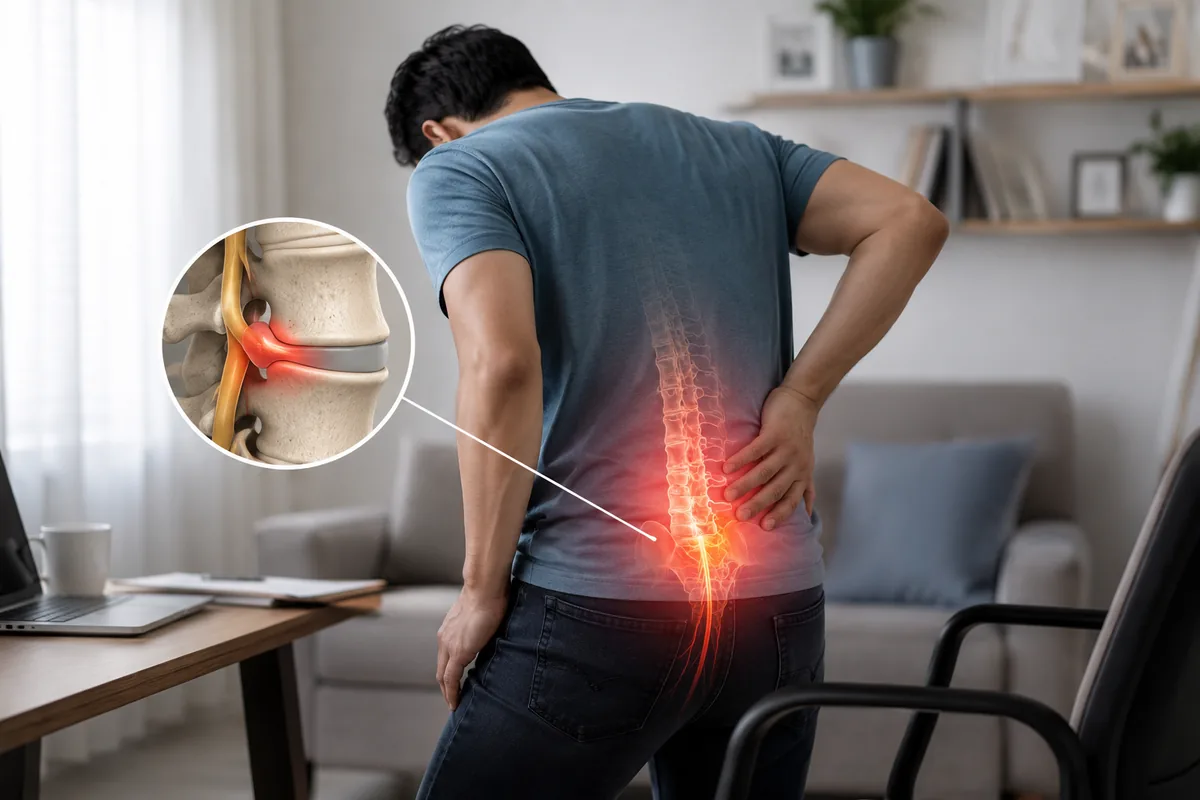
Does this sound like you?
Back zone
- Chronic lower back pain: a dull ache or tightness that has come and gone for months
- Pain radiating into the leg: from the back or buttock down the thigh, calf, or into the foot
- Numbness or tingling down one leg, sometimes with an electric feeling when you cough or sneeze
- Pain when sitting for long periods: long meetings or long drives force you to stand and stretch
- Pain on lifting: it started with a heavy or awkward lift and stayed for days
- Leg pain or numbness on standing and walking that eases when you sit or lean forward
- Pain on arching backwards or twisting, which often points towards the small joints at the back of the spine
Neck zone
- Chronic neck pain: aching in the neck or across the shoulders, with restricted turning
- Pain radiating into the arm: from the neck into the shoulder blade, upper arm, forearm, or fingers
- Numbness in the hand: tingling fingers, or a grip that no longer feels reliable
- Desk-related neck, shoulder, and upper back pain from long screen hours and sustained postures
- Pain that builds through the afternoon and settles on days off
- Headache arising from the neck: a dull ache from the base of the skull upwards, usually with neck tightness
Both zones can coexist in the same person, particularly with long desk hours and repeated sustained postures.
02
Common causes
The two zones share the same structures, so the causes overlap: overloaded muscles and ligaments from sustained posture, repetitive use, or stress; degenerated, inflamed facet joints at the back of the spine, which typically hurt on backward bending or twisting; degenerated or herniated discs pressing on a nerve root, causing radiating pain, numbness, or weakness; spinal canal narrowing, more common with age, causing leg symptoms on standing and walking; and myofascial trigger points, tight bands within muscle that refer pain elsewhere.
03
Treatment options, from least to most invasive
| Step | What it involves | Who it suits | Limitations to know | Starting from (THB) |
|---|---|---|---|---|
| 1. Posture and activity | Desk and screen setup, regular movement breaks, lifting technique, staying active rather than resting in bed | Everyone; the foundation of all other options | Needs consistency, and symptoms tend to return with old habits | Self-care, no clinic fee |
| 2. Physiotherapy and exercise | Core or neck and shoulder strengthening, postural balance, flexibility | Chronic symptoms without red flags | Takes weeks of consistent work before change shows | Quoted after physician assessment |
| 3. Medication | Pain or anti-inflammatory medication as considered by the medical team (generic names only) | Flare-ups, or to create a window for rehabilitation | Manages symptoms rather than the source · Caution with stomach, kidney, or cardiac conditions | Quoted after physician assessment |
| 4. Image-guided needle procedures | See the list below; guided by imaging, needle-only, no hospital stay | Persistent pain after steps 1–3, where the source can be reasonably identified | Relieves symptoms rather than reversing structural change · Some procedures may need repeating · Response varies between individuals | 22,000 |
| 5. Surgery | A later-line option | Clear indications such as nerve compression with progressive weakness, or severe symptoms unresponsive to other care | Longer recovery and surgical risks weighed individually | Quoted after physician assessment |
Which of these options is appropriate depends on your imaging, your medical history, and how your symptoms have responded to previous treatment. At YOUNIFY Clinic, a physician reviews these together with you before any treatment is planned. Results vary by individual.
This tool helps you find relevant information. It does not provide a diagnosis.
04
The procedures we actually perform
All of the following are carried out by our pain medicine physicians, using image guidance (X-ray or ultrasound) to place the needle precisely. They are needle-only, involve no surgical incision, need no hospital stay, and patients generally go home the same day, using equipment that meets international standards.
- Diagnostic medial branch block: a small volume of local anaesthetic at the nerves supplying a facet joint, to confirm whether that joint is genuinely the source before any larger step is considered
- Medial branch radiofrequency ablation (RFA): radiofrequency energy used to reduce pain signalling from a facet joint, considered for people who responded well to the diagnostic block
- Facet joint injection: steroid or prolotherapy delivered into the joint; which agent is used is decided case by case
- Cervical epidural steroid injection: for neck pain radiating into the arm from an inflamed nerve root, reducing inflammation around the nerve so rehabilitation can progress
- Selective cervical nerve root injection: targeted at the suspected nerve root, useful both to relieve symptoms and to help identify which root is responsible
- Trigger point injection: for tight, tender bands in the neck, shoulder, or back muscles; used alongside physiotherapy rather than on its own
All of these aim to relieve symptoms and open a window for rehabilitation. They do not undo structural degeneration. The medical team explains individual risks and realistic expectations before every procedure.

05
What assessment involves, and what can be done before you fly
- Detailed history: where the pain sits and radiates, what provokes and eases it, its effect on sleep and work, and everything already tried
- Neurological and musculoskeletal examination: power, sensation, reflexes, range of motion, and tests that help separate joint, disc, and muscle sources
- Imaging where it will change the plan: not everyone needs an MRI, and an abnormal scan does not automatically identify the source; images are always read alongside symptoms
- A stepwise plan agreed together: if a less invasive step has not had a fair run, our medical team will say so before considering a procedure
Much of steps 1–3 can be prepared remotely. Send your symptom history, current medication, and any spine X-ray or MRI from the last 12 months, and we can indicate before you book flights whether an image-guided procedure is a realistic part of the plan. Since these procedures are needle-only with same-day discharge for most patients, consultation, procedure, and early review can usually be arranged in a single trip.
06
When to seek care immediately (red flags)
Most back and neck pain is not dangerous, but the following should not be watched and waited on. Seek medical care or go to an emergency department right away.
- Clear weakness in a leg or arm, particularly if it is worsening; also unsteady walking, loss of balance, or hands losing fine control
- Numbness around the buttocks, perineum, and genitals (saddle numbness)
- Loss of bladder or bowel control, or new difficulty passing urine
- Fever with back or neck pain, especially with a history of infection, immunosuppressant use, or a recent spinal injection
- Unexplained weight loss, or severe night pain that wakes you
- A history of cancer with new or changed back or neck pain
- Back or neck pain after trauma such as a road accident, a fall, or a fall from height
Saddle numbness together with loss of bladder or bowel control may indicate cauda equina compression, which needs urgent evaluation.
07
What to read next
If your problem is in the back
- "Show me the full picture for back pain first" → Chronic back pain and pain radiating to the leg · the main back guide, from causes to every level of treatment
- "Is this leg pain sciatica?" → Sciatica treatment · the symptom pattern, causes, and how it is managed
- "I've been told I have a herniated disc. Do I need surgery?" → Lumbar herniated disc · symptoms, diagnosis, and when surgery is genuinely considered
- "What is an epidural steroid injection and what is it like?" → Epidural steroid injection for back pain · the procedure, who it suits, and what to expect
- "My pain is from sitting and lifting. What can I change?" → Lower back pain from lifting and sitting · lifting technique, desk setup, and practical exercises
If your problem is in the neck
- "Show me the full picture for neck pain first" → Chronic neck pain treatment · the main neck guide, from causes to every level of treatment
- "My neck pain runs into my arm and my hand tingles" → Neck pain radiating to the arm (cervical radiculopathy) · what nerve root irritation looks like and how it is treated
- "Screen work all day and my neck and shoulders ache" → Office syndrome: neck and shoulder pain · posture changes, stretches, and when it is no longer just posture
- "What is a cervical herniated disc?" → Cervical herniated disc · symptoms, diagnosis, and treatment options
- "What is radiofrequency ablation for neck pain?" → Radiofrequency ablation for neck pain · the principle, who it suits, the procedure, and realistic expectations
If your question is cost
- "What do these procedures cost?" → Cost of radiofrequency ablation and epidural steroid injection · what is included and how to plan for it
- "Show me other conditions you treat" → All conditions
Câu hỏi thường gặp
Does everyone with chronic back or neck pain need an MRI?
No. Imaging is requested when it will change the plan, based on your symptoms and examination. An abnormal finding does not automatically identify the source of your pain, which is why images are always read alongside the clinical picture.
Do image-guided procedures require a hospital stay?
No. They are needle-only under image guidance. Patients are observed for a short period and generally go home the same day, with aftercare guidance and advice on returning to activity.
Will a procedure fix the problem permanently?
These procedures relieve symptoms and open a window for rehabilitation rather than reversing structural degeneration. How long relief lasts varies between individuals, and some people need a repeat in future. Consistent rehabilitation and posture change are what extend the benefit.
Why is a diagnostic injection needed before radiofrequency ablation?
Because the diagnostic block confirms that the facet joint is genuinely the source before a larger step is taken. It reduces the chance of treating the wrong structure.
I have both neck and back pain. Are these treated separately?
Not necessarily in separate visits. One assessment can cover both zones, though the treatment plan is set per zone, since the underlying structure may differ.
Bài viết liên quan
Lưu Ý Y Khoa
Bài viết này chỉ mang tính thông tin chung và không thay thế cho việc thăm khám, chẩn đoán hay điều trị y khoa. Nếu triệu chứng nặng, thay đổi nhanh hoặc cấp bách, hãy đi khám ngay.
Kết quả có thể khác nhau ở mỗi người. Vui lòng tham khảo ý kiến bác sĩ trước khi điều trị.
Quý khách muốn biết kế hoạch chăm sóc nào phù hợp với mình?
Chia sẻ triệu chứng, tiền sử sức khỏe, thuốc đang dùng hoặc các thủ thuật đã thực hiện trước đây và mục tiêu cá nhân của Quý khách. Đội ngũ của chúng tôi có thể hỗ trợ sắp xếp buổi đánh giá y khoa.