Most neck lumps are thyroid nodules, and only about 5% turn out to be cancer. Here are the common causes, the lumps that are not thyroid, and the red flags.
Contents
Key Takeaways
- Thyroid nodules are very common: ultrasound finds one in roughly half of all adults, and only about 5% of nodules turn out to be cancer.
- The usual causes are colloid nodules, cysts, benign adenomas, thyroiditis and multinodular goitre — none of them cancer, though all still need proper assessment.
- A lump on the side of the neck that does not move when you swallow is often not thyroid at all: it may be a lymph node, a salivary gland, or a skin cyst.
- See a doctor sooner if the lump grows quickly, your voice stays hoarse, the lump feels hard and fixed, swallowing or breathing becomes difficult, you had childhood radiation to the neck, or thyroid cancer runs in your family.
What is a neck lump, and where does it come from?
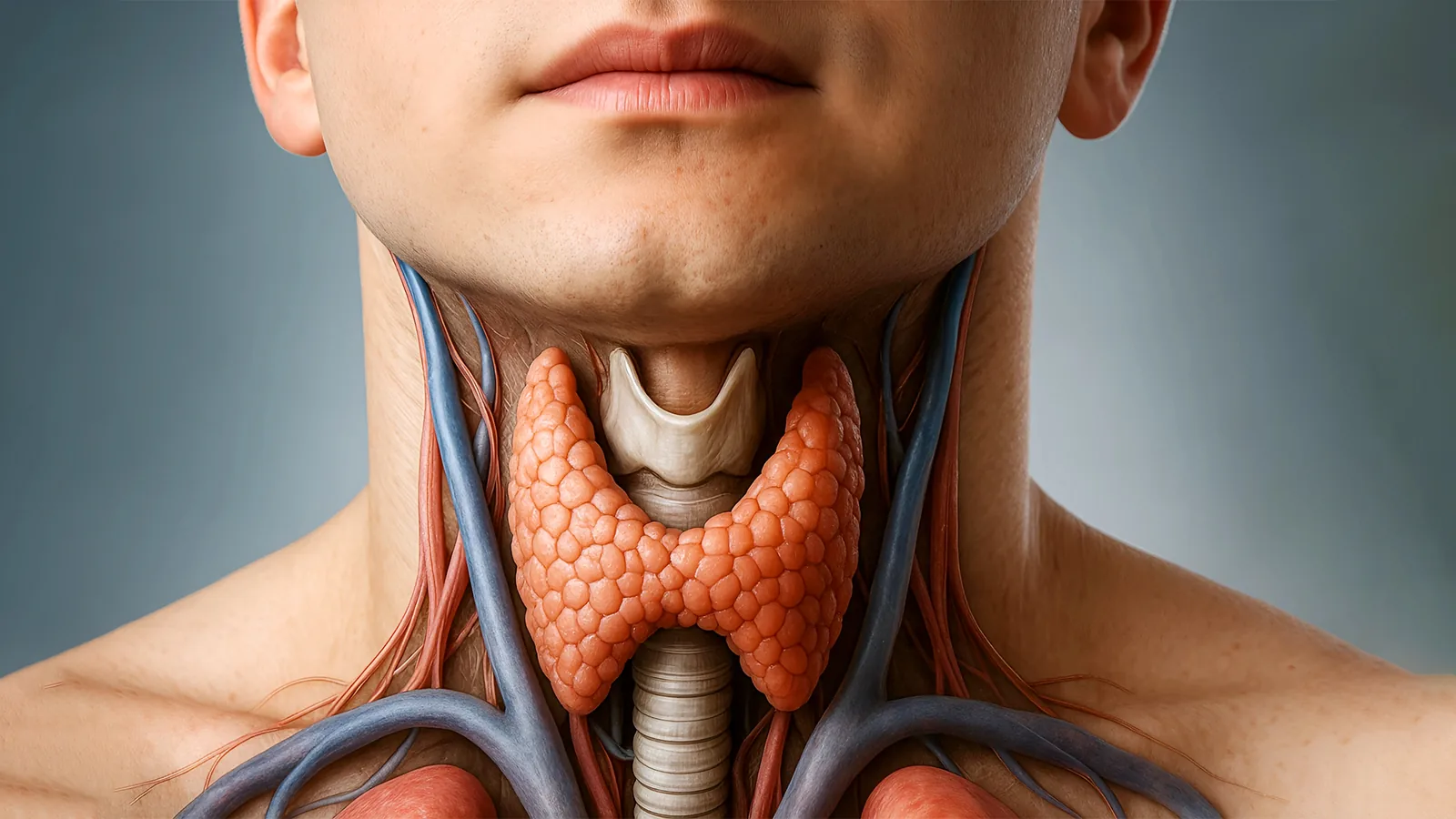
Most neck lumps come from one of two places: the thyroid gland, in the middle of the front of the neck just below the Adam's apple, or the lymph nodes running down both sides. A thyroid lump usually sits centrally and slides up and down when you swallow. A lump that stays still while you swallow is usually something else.
Many people never feel the lump themselves. It turns up by chance on a health check, a carotid ultrasound, or a CT scan done for another reason. Used carefully, ultrasound finds nodules in roughly half of all adults — so having one is far more ordinary than it feels on the day you are told.
Of thyroid nodules that go through a full workup, only about 5% are cancer. What no one can do is tell which is which by feel, or by size alone. That separation is made by what the ultrasound shows and, when needed, a needle sample of the cells — the pathway described in what to do after a thyroid nodule is found.
What causes thyroid nodules?
A nodule forms when one part of the thyroid grows out of step with the rest and becomes a discrete lump. The most frequent causes are colloid nodules and simple cysts, followed by benign adenomas, inflammation of the gland, and multinodular goitre. Cancer accounts for the smallest share.
- Colloid nodule — normal thyroid tissue that has enlarged and stored colloid inside. The commonest type, benign, and usually stable or very slow-growing over years.
- Thyroid cyst — a fluid-filled lump. If a small vessel bleeds inside it, the lump can swell and become sore within a day or two — alarming, but not in itself a sign of cancer.
- Follicular adenoma — a solid, benign growth with a clear capsule. It grows slowly and does not invade, but sometimes only surgery separates it from its malignant counterpart with certainty.
- Thyroiditis — chronic autoimmune inflammation (Hashimoto's) or subacute inflammation after a viral illness, leaving the gland swollen or uneven. Subacute cases can be sore, with a low fever.
- Multinodular goitre — the whole gland enlarges and develops several nodules at once. It becomes more common with age and is linked to long-term low iodine intake.
- Autonomously functioning (toxic) nodule — makes thyroid hormone on its own, causing palpitations, tremor, weight loss, heat intolerance and poor sleep.
- Thyroid cancer — about 5% of nodules. The commonest form, papillary thyroid cancer, generally grows slowly and responds well to treatment when picked up early.
So “thyroid nodule” is not one disease but an umbrella term for conditions managed very differently. Telling them apart relies on an ultrasound reading the margins of the lump, how solid the tissue looks, any tiny calcifications and its shape, plus a blood test of thyroid function and, for selected nodules, a needle biopsy.
Neck lumps that are not thyroid
Not every neck lump involves the thyroid. Lumps at the side of the neck, under the jaw or behind the ear that do not move on swallowing usually come from lymph nodes, salivary glands, the skin, or a cyst present since birth. Location alone narrows the list considerably before any scan.
| Type of lump | Typical features |
|---|---|
| Enlarged lymph node | Sides of the neck or under the jaw; often follows a sore throat, tender, settles in two to three weeks |
| Skin (epidermoid) cyst | Very superficial, moves with the skin, sometimes with a tiny central opening; can flare up red |
| Lipoma | Soft, smooth-edged, not tender, grows very slowly and does not change with swallowing |
| Salivary gland swelling or stone | Under the jaw or in front of the ear; typically swells and hurts more while eating |
| Congenital cyst | A midline cyst that moves when the tongue is stuck out, or one on the side of the neck; usually noticed young |
One caution: a lymph node enlarged beyond three to four weeks with no obvious infection, feeling hard and unchanging, should always be examined. Some thyroid cancers first present as an enlarged neck node while the nodule itself is still too small to feel.
Who is more likely to develop a thyroid nodule?
Most nodules appear with no identifiable cause. Some factors make them more likely: older age, being female, low iodine intake, chronic thyroid inflammation, and family history. These predict how likely you are to have a nodule — not whether the one you have is cancer.
- Age — nodules become steadily more common with each decade, particularly multinodular goitre from middle age onwards.
- Female sex — women develop nodules several times more often than men, often first detected in the reproductive years.
- Iodine intake — long-standing low iodine is linked to goitre; a sudden excess can also disturb how the gland works.
- Family history — a parent or sibling with nodules, goitre, or thyroid cancer.
- Radiation to the head or neck in childhood — the clearest single risk factor for thyroid cancer, and worth telling your doctor every time.
- Hashimoto's thyroiditis — chronic inflammation makes the gland uneven and nodules more likely to form.
Patients often ask whether stress, diet, or eating seafood causes nodules. Current evidence does not clearly support those ideas, and changing your diet alone will not make an existing nodule disappear.
Red flags: when to see a doctor sooner
Most thyroid nodules cause no symptoms at all. A few features mean the assessment should happen within weeks rather than being watched at home. None proves cancer — each is simply reason enough to book an ultrasound and a clinical examination promptly.
- The lump grows noticeably over a few weeks to a few months
- Hoarseness lasting beyond two weeks without a cold or heavy voice use
- A hard lump with irregular edges that feels fixed to the tissue around it
- Difficulty swallowing, a feeling of food catching, or breathlessness that is worse lying flat
- Enlarged neck lymph nodes alongside the lump that do not settle
- Radiation treatment to the head or neck during childhood
- A first-degree relative with thyroid cancer or an inherited endocrine syndrome
The reverse is also true: having none of these does not mean the lump can be ignored. Early thyroid cancer is usually silent, causes no discomfort, and does not upset hormone levels. That is why international guidance recommends assessing every detected nodule with ultrasound rather than judging it by symptoms.
What happens after a nodule is found
The standard sequence is a blood test of thyroid function, an ultrasound grading the nodule's risk pattern, then a decision about whether a fine-needle aspiration (FNA) is warranted. The cell result is reported using the Bethesda system, which points towards monitoring, repeat sampling, or surgery — the full pathway is set out in what to do after a thyroid nodule is found.
Nodules that come back benign and cause no symptoms usually need nothing more than periodic ultrasound follow-up. Surgery is reserved for genuine indications — a nodule pressing on the windpipe or oesophagus, a suspicious or malignant biopsy result, or a nodule overproducing hormone. Those are discussed in does a thyroid nodule need surgery?
For nodules confirmed benign on FNA that still cause a visible bulge or a tight feeling on swallowing, radiofrequency ablation (RFA) can shrink the nodule without an incision and without removing thyroid tissue. The important condition is that RFA applies only to nodules proven benign by needle biopsy; cancer or suspected cancer is managed along a completely different route. The two are compared in thyroid RFA versus surgery.
Talking it through with our medical team
If you have felt a lump, or a screening report mentions a nodule, the first step is an ultrasound and blood test with our medical team — not a decision about surgery before the nature of the lump is known. Outcomes vary with the type of nodule, its size, and your general health.
YOUNIFY Clinic is at 2nd Floor, Room 214, United Center Building, 323 Silom Road, Silom, Bang Rak, Bangkok 10500, Thailand, a short walk from BTS Sala Daeng, open daily 11:00–20:00. Call 081-556-9696 or add LINE @younifyclinic. International patients can send imaging reports ahead of travelling.
Frequently Asked Questions
I found a lump in my neck myself. Should I be worried?
Finding a lump does not mean something serious. Most neck lumps are benign, and among thyroid nodules given a full workup only about 5% are cancer. Since no one can tell the difference by touch, the sensible response is a single ultrasound assessment.
Is a thyroid nodule caused by diet or iodine?
Long-term low iodine intake is associated with goitre and multiple nodules. In people with adequate iodine, though, most nodules have no dietary cause, and changing what you eat will not shrink a nodule that has already formed.
Can a thyroid nodule go away on its own?
Some simple cysts shrink once the fluid is reabsorbed, and lumps from subacute thyroiditis settle as the inflammation resolves. Colloid nodules and benign adenomas tend to persist or enlarge slowly, so they are followed up at intervals.
Does a growing lump mean cancer?
Not necessarily. Benign nodules enlarge over time, and a cyst that bleeds internally can swell within days. Rapid growth combined with hoarseness, a hard fixed lump, or enlarged neck nodes is what warrants an earlier appointment.
Will a nodule upset my thyroid hormone levels?
Most people with nodules have normal hormone levels. Only some produce hormone independently, causing palpitations, tremor and weight loss, while chronic thyroiditis can lead to an underactive gland. A blood test is part of the first assessment.
Does every nodule need an operation?
No. Nodules confirmed benign and causing no symptoms are usually just monitored with ultrasound. Surgery is kept for clear indications; for benign nodules that bother a patient cosmetically or when swallowing, radiofrequency ablation is an alternative to discuss with our medical team.
References
- 2015 American Thyroid Association Management Guidelines for Adult Patients with Thyroid Nodules and Differentiated Thyroid Cancer (Thyroid. 2016;26(1):1–133. PMID: 26462967)
- 2017 Thyroid Radiofrequency Ablation Guideline: Korean Society of Thyroid Radiology (Korean J Radiol. 2018;19(4):632–655. PMID: 29962870)
Medical Note
This article is for general information and does not replace medical examination, diagnosis, or treatment. If symptoms are severe, changing quickly, or urgent, seek medical care promptly.
Individual results may vary. Please consult a doctor before treatment.
Want to know which care plan fits you?
Share your symptoms, health history, medications or prior procedures, and personal goals. Our team can help arrange a medical assessment.
Consult YOUNIFY Clinic