Found a thyroid nodule? Step by step from YOUNIFY's medical team: blood tests, ultrasound risk grading, when a needle biopsy is needed, and the options that follow.
Contents
Key Takeaways
- The workup follows a set order: history and physical examination, a blood test of thyroid function, an ultrasound that grades the nodule's features, and only then a decision about whether a needle biopsy is needed.
- Thyroid nodules are very common. Ultrasound finds one in roughly half of all adults, and only about 5% of nodules turn out to be cancer.
- Not every nodule needs a biopsy, and not every nodule needs treatment. Periodic ultrasound monitoring is a legitimate and very common endpoint, not a way of avoiding a decision.
- Radiofrequency ablation (RFA) is an option only for nodules confirmed benign on biopsy. Cancer or suspected cancer is managed along a different pathway, where surgery remains the main approach.
A thyroid nodule was found — what happens next?
The standard pathway is the same almost everywhere: history and examination, a blood test of thyroid function, then an ultrasound that describes the nodule in detail. Only after those three steps can a doctor say whether the nodule needs a needle biopsy or simply periodic monitoring. Nothing here has to happen on the same day.
Thyroid nodules are far more common than most people expect. When ultrasound is used to look for them, nodules are found in roughly half of all adults, and only about 5% of them turn out to be cancer. The rest are cysts, ordinary benign growths, or changes left behind by inflammation. If you are still wondering where a neck lump comes from in the first place, see what causes thyroid nodules and neck lumps.
This guide from the YOUNIFY medical team maps the whole route in advance, so you know what each test is for, why it is being done, and where each possible result leads.
- Step 1 — history and examination of the neck
- Step 2 — a blood test of thyroid function (TFT)
- Step 3 — thyroid ultrasound, with the nodule's features graded for risk
- Step 4 — fine-needle aspiration (FNA) biopsy, for nodules that meet the criteria
- Step 5 — the plan that follows: monitoring, surgery, or ablation of a confirmed benign nodule
For most people this is not an emergency, and an appointment within the next few weeks is reasonable. Sooner review is sensible if the lump is growing noticeably over weeks, if the voice has become hoarse and stayed that way, if swallowing or breathing feels obstructed, or if a hard, fixed lymph node can be felt in the neck.
Step 1: history and examination
The first step needs no equipment. Your doctor will ask when the lump appeared, how quickly it has changed, whether it presses on anything, and whether there is a history of radiation to the head or neck in childhood or thyroid cancer in the family. Then the thyroid and the lymph nodes of the neck are examined by hand.
These questions are not a formality. Childhood neck irradiation, a family history, rapid growth, a persistently hoarse voice, or a lump that feels hard and fixed all shift the risk assessment, and may lead a doctor to biopsy a nodule earlier than its size alone would suggest.
The history also separates hormone symptoms from symptoms caused by the lump itself. Palpitations, tremor, weight loss and heat intolerance point towards an overactive thyroid; fatigue, feeling cold and weight gain point the other way. Either pattern changes the next step.
Step 2: a blood test of thyroid function
A thyroid function test, usually starting with TSH, comes next. Its purpose is not to detect cancer — blood tests cannot do that — but to establish whether the gland is working normally, overworking, or underworking. That single piece of information genuinely changes the route you take from here.
If TSH is below the normal range, the nodule may be producing hormone on its own. A thyroid scan is then often considered first, to see whether the nodule is the overactive part of the gland. Nodules of this type carry a low likelihood of cancer and are managed differently.
If thyroid function is normal or low, the pathway continues to ultrasound as usual. Thyroid antibodies may be added when chronic thyroid inflammation is suspected alongside the nodule.
Step 3: ultrasound and risk assessment of the nodule
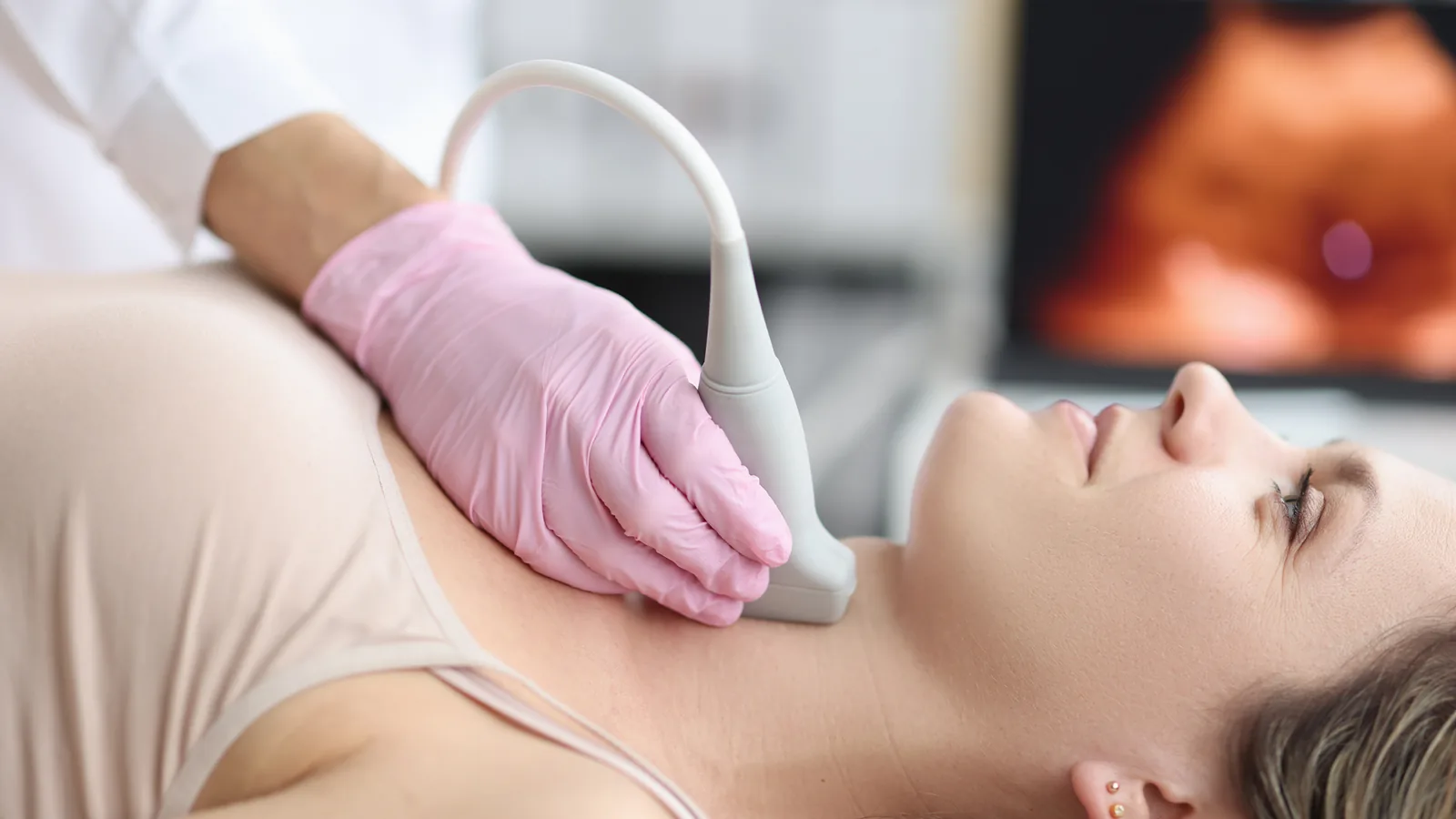
Ultrasound is the single most informative test in this pathway. It takes a few minutes, uses no radiation, and needs no preparation. The scan records how many nodules there are and how large, whether they are fluid or solid, whether the margins are smooth, whether there are tiny calcifications, whether the shape is taller than wide, and whether any neck lymph node looks abnormal.
Those features are combined into a risk grade, and international guidance uses that grade to decide when a nodule should be sampled. The principle is simple: the more suspicious the appearance, the smaller the nodule needs to be before a biopsy is considered. A nodule with a reassuring appearance is usually left until it is considerably larger, or simply watched.
| Appearance on ultrasound | Risk trend | Approach to biopsy (approximate) |
|---|---|---|
| Simple cyst, or almost entirely fluid | Very low | Usually no diagnostic biopsy; a needle may be used to drain it only if it grows enough to cause symptoms |
| Solid but reassuring — smooth margins, even texture, no tiny calcifications | Low | Biopsy usually considered only once the nodule is fairly large; otherwise followed by ultrasound |
| Intermediate appearance, neither clearly reassuring nor clearly suspicious | Moderate | Biopsy usually considered from a moderate size upwards |
| Suspicious features — irregular margins, taller than wide, tiny calcifications, markedly dark solid tissue | Higher | Biopsy considered at a smaller size than for the other groups |
| Any nodule accompanied by an abnormal-looking neck lymph node | Needs separate assessment | Both the nodule and the lymph node are usually sampled, without waiting for further growth |
The exact size thresholds differ slightly between published guidelines, and a doctor always weighs them against your history, your age and your own concerns. Treat this table as the reasoning behind the advice you are given rather than as a rule that can replace an actual assessment.
Step 4: does every nodule need a needle biopsy?
No. Fine-needle aspiration is offered only to nodules that meet the criteria set by their ultrasound appearance and size. A large share of nodules are assessed and then simply rescanned at intervals, which is a correct outcome under international guidance rather than a decision being avoided.
For those who do need it, the procedure is simpler than most people picture. You lie on your back with a small support under the shoulders, the skin is cleaned, local anaesthetic is given, and a fine needle — close in size to a blood-test needle — is passed into the nodule under continuous ultrasound guidance to draw out cells for the laboratory.
- A fine needle is used; there is no incision, no general anaesthetic and no stitches
- The whole procedure is guided by ultrasound so the needle reaches the intended part of the nodule
- Each pass takes only a few minutes, and two or three samples are usually taken from the same nodule
- Most people describe pressure and a brief sharp sensation, similar to a blood draw, though the experience varies from person to person
- Mild neck soreness or a small bruise for a day or two afterwards is normal; you go home the same day and carry on as usual
One thing worth knowing in advance: a single biopsy does not always give an answer. Sometimes too few cells are recovered for the pathologist to report on, and a repeat sampling is arranged. This is an ordinary feature of the test, not a sign that something worrying has been found.
What the biopsy result means
Thyroid biopsy results are sorted into standard categories known as the Bethesda system, so that clinicians everywhere describe the same findings in the same way and can attach a broad likelihood of cancer to each group. In plain language, the main categories are as follows.
- Not enough material to assess — too few cells were recovered to report on, and a repeat biopsy is usually arranged
- Benign — the most common result by far; usually followed by periodic ultrasound rather than surgery
- Indeterminate — the cells show some abnormal features, but not enough to classify them; may lead to a repeat biopsy, further testing, or diagnostic surgery in selected cases
- Suspicious for malignancy — the appearance leans strongly towards cancer without being conclusive; surgery is usually recommended
- Malignant — the appearance is clear, and surgery with an ongoing plan agreed with the medical team is the main route
Seen as a whole, around 95% of thyroid nodules are not cancer. Most people therefore receive a benign result, and the advice that follows is a monitoring interval rather than treatment. Knowing that in advance takes much of the anxiety out of the waiting period.
An indeterminate result also does not mean cancer. It means the information so far is not enough to conclude. Decisions in this group draw on everything together: the ultrasound appearance, the size, any symptoms, your age, and your own preference.
What are the options once the result is in?
From here the path splits three ways: monitoring alone, surgery, or treating the nodule without surgery when it has been confirmed benign and is causing symptoms. Each has its own indications, and doing more is not automatically the more appropriate choice.
Monitoring is the most common outcome for a benign nodule that is not large and not causing symptoms. In practice it means a repeat ultrasound at intervals to check whether the nodule is growing or changing. If it stays stable and silent, doing nothing further is the right answer.
Surgery remains the main route when the biopsy is malignant or suspicious, and also for very large nodules pressing on the windpipe or oesophagus. It has consequences worth knowing in advance: after removal of one thyroid lobe, roughly 30% of people become hypothyroid, and about one in four end up taking thyroid hormone tablets. For a fuller look at when an operation is genuinely indicated, see does a thyroid nodule need surgery.
For nodules confirmed benign on biopsy but which are visible, feel tight in the neck, catch on swallowing, or affect confidence, radiofrequency ablation (RFA) is one option performed through the skin without an incision. Published studies report that treated nodules typically shrink by around 50–80% of their volume over 6–12 months, although individual results vary. To weigh the two approaches side by side, see thyroid RFA compared with surgery.
One limit has to be stated plainly: RFA is used only for nodules confirmed benign on biopsy. Cancer, or a nodule suspected of being cancer, is managed along a different pathway, and ablation is not a substitute for surgery in those cases.
At YOUNIFY Clinic our medical team reviews the ultrasound, the blood results and the biopsy report before discussing the options with you. Thyroid ablation starts from ฿65,000. The clinic is at 2nd Floor, Room 214, United Center Building, 323 Silom Road, Silom, Bang Rak, Bangkok 10500, Thailand — a short walk from BTS Sala Daeng — open daily 11:00–20:00. Call 081-556-9696 or LINE @younifyclinic.
Frequently Asked Questions
A thyroid nodule was found — do I need to be seen urgently?
In most cases this is not an emergency, and an appointment within a few weeks is reasonable. Seek review sooner if the lump is visibly growing over a matter of weeks, if hoarseness persists, if swallowing or breathing feels obstructed, or if you can feel a hard, fixed lymph node in the neck.
Does every thyroid nodule need a biopsy?
No. The decision rests on the nodule's ultrasound appearance together with its size and your history. Nodules that look reassuring on ultrasound and are not large are commonly followed with periodic scans instead, which is a correct outcome under international guidance.
How uncomfortable is a thyroid needle biopsy?
A fine needle close in size to a blood-test needle is used, with local anaesthetic and continuous ultrasound guidance. Most people report pressure and a brief sharp sensation, and the sampling itself takes only minutes. Mild soreness or a small bruise for a day or two afterwards is common, though experiences vary between individuals.
What if the biopsy comes back as an inadequate sample?
A repeat biopsy is usually arranged. This happens routinely with this test and does not mean the nodule has become more concerning. Repeating the sampling under ultrasound guidance improves the chance of collecting enough cells for the pathologist to report on.
My biopsy was benign — do I need any treatment?
Usually not. Periodic ultrasound monitoring is enough for most benign nodules. Treatment is considered when the nodule grows enough to cause symptoms such as neck tightness, catching on swallowing, breathing discomfort, or a visible change in the neck. The options at that point are surgery or radiofrequency ablation.
Can radiofrequency ablation be used on a cancerous nodule?
No. Current guidance restricts RFA to nodules that a biopsy has confirmed to be benign. Nodules that are malignant or suspicious for malignancy are managed along a different pathway, in which surgery remains the main treatment.
References
- 2015 American Thyroid Association Management Guidelines for Adult Patients with Thyroid Nodules and Differentiated Thyroid Cancer (Thyroid. 2016;26(1):1–133. PMID: 26462967)
- 2017 Thyroid Radiofrequency Ablation Guideline: Korean Society of Thyroid Radiology (Korean J Radiol. 2018;19(4):632–655. PMID: 29962870)
- Efficacy and Safety of Radiofrequency Ablation Versus Observation for Nonfunctioning Benign Thyroid Nodules: A Randomized Controlled International Collaborative Trial (Thyroid. 2015;25(8):890–896. PMID: 26061686)
- Prevalence of and risk factors for hypothyroidism after hemithyroidectomy: a systematic review and meta-analysis (Endocrine. 2020;70(1):7–15. PMID: 32638212)
Medical Note
This article is for general information and does not replace medical examination, diagnosis, or treatment. If symptoms are severe, changing quickly, or urgent, seek medical care promptly.
Individual results may vary. Please consult a doctor before treatment.
Want to know which care plan fits you?
Share your symptoms, health history, medications or prior procedures, and personal goals. Our team can help arrange a medical assessment.
Consult YOUNIFY Clinic