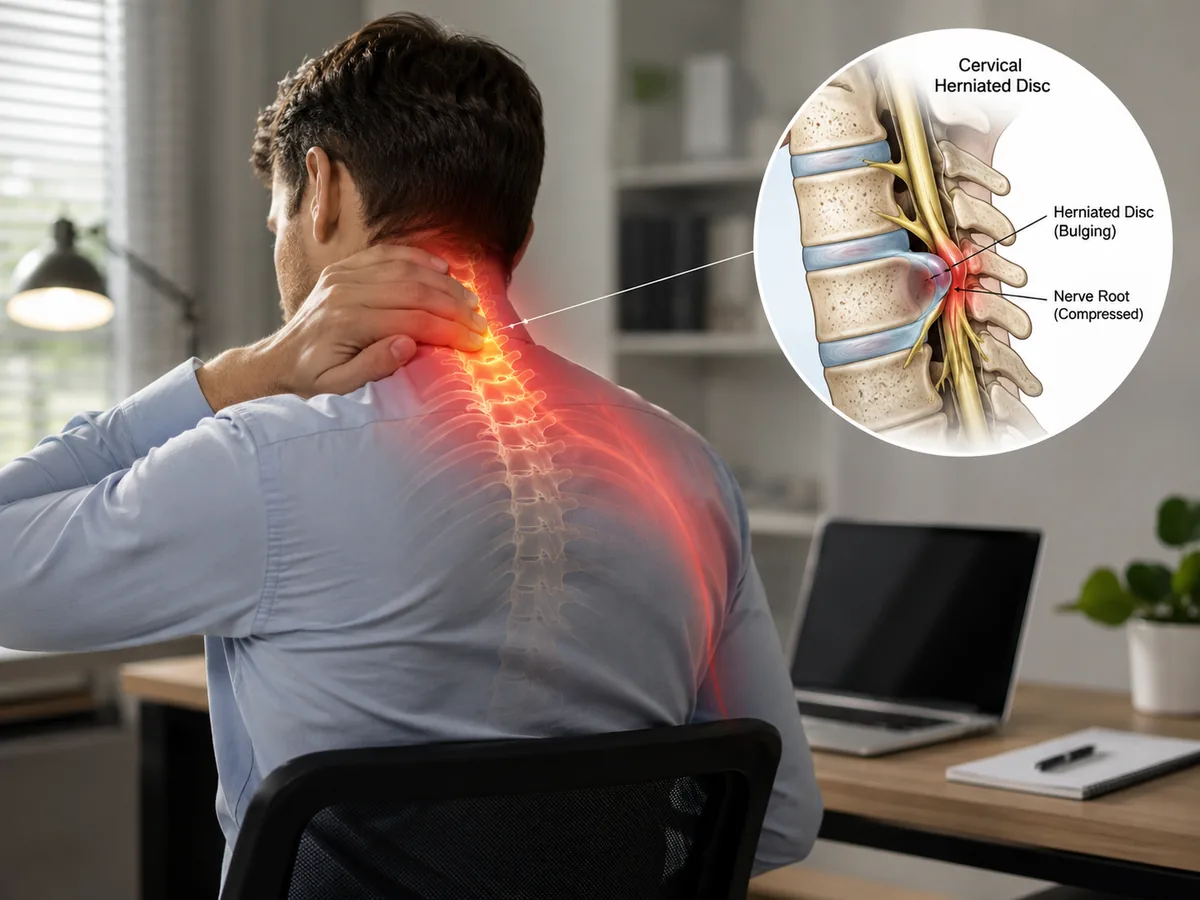
What a cervical herniated disc is, why it causes neck pain radiating down the arm with numbness, how MRI confirms it, and non-surgical to surgical options — explained by the YOUNIFY Clinic medical team, Silom, Bangkok.
Contents
Key Takeaways
- A cervical herniated disc occurs when a disc in the neck bulges or ruptures and presses on a nerve root supplying the arm, causing neck pain that radiates down the arm with numbness — most often at the C5-C6 and C6-C7 levels.
- Most people improve with non-surgical care such as posture correction, physiotherapy, medication, and in selected cases an image-guided injection; surgery is a last-line option.
- See a doctor promptly if weakness worsens, both arms are numb, balance and walking deteriorate, or bladder or bowel control becomes difficult — these are warning signs of spinal cord compression.
What is a cervical herniated disc?
A disc is a cushion that sits between the bones of your neck, absorbing shock and allowing movement. When the tough outer layer tears and the soft gel inside pushes out and presses on a nerve root running to the arm, the result is a cervical herniated disc. Pain and numbness then travel along the path of that nerve.
The neck has seven vertebrae, and herniation most often occurs at the C5-C6 and C6-C7 levels, which carry load and move a great deal. When a nerve root is compressed, the pain and numbness follow that specific nerve's route — down to the shoulder, upper arm, forearm, or fingertips — depending on which level is affected. This gives each pattern a signature that helps the doctor predict the location of the problem from the history alone.
What do the symptoms feel like: neck pain, arm radiation, numbness
The hallmark is one-sided neck pain that radiates down the arm along a nerve's path, together with numbness or an electric, tingling sensation in the hand. Some people notice weakness in the arm or hand and drop objects easily. Symptoms often worsen with looking up, coughing, sneezing, or straining, and ease with rest in a comfortable position.
Common patterns include a dull ache at the base of the neck and shoulder blade, sharp shooting pain down the arm with certain neck movements, a band of numbness reaching the thumb, index, or little finger depending on the level, and weakness when lifting the arm or gripping. If numbness or weakness affects both arms, if balance and walking worsen, or if bladder or bowel control becomes difficult, these are warning signs of spinal cord compression and need prompt medical review — a more urgent situation than a single compressed nerve root. You can read more about arm-radiating pain in our article on neck pain radiating to the arm and cervical radiculopathy.
What causes it and who is at risk?
The main cause is age-related disc degeneration, which makes the outer layer more brittle and prone to tearing. Contributing factors include prolonged forward head posture from screens, lifting heavy objects with poor technique, smoking, higher body weight, and neck injury. These factors increase load and speed up disc wear.
In daily life, the "forward head" posture from long phone and computer use steadily raises pressure on the cervical discs. Over years, combined with natural degeneration, the disc wall weakens and can herniate even with a small movement such as a quick twist or a sudden turn of the head. Attention to posture, a well-set-up desk, and quitting smoking are therefore long-term measures that help slow degeneration and lower the chance of recurrence.
How is it diagnosed — do you need an MRI?
Diagnosis begins with your history and a neurological examination of muscle strength, sensation, and reflexes. MRI shows the disc and nerve roots clearly, but it is not needed for everyone. Your doctor will consider it when symptoms are severe, last too long, or come with neurological warning signs.
In general, if symptoms are mild and there are no red flags, doctors often start with supportive care and monitor progress, because many people improve over time. MRI becomes most useful when symptoms do not respond to initial care, when there is clear weakness, or when a procedure or surgery is being planned. Nerve conduction and muscle studies (EMG/NCS) may also be used to confirm which nerve root is affected and to distinguish other causes of hand numbness. The diagnostic equipment at YOUNIFY Clinic meets international standards, and your doctor will explain the findings clearly before any decision is made together.
Non-surgical versus surgical treatment — what is the difference?
Most people are managed without surgery: posture correction, physiotherapy, pain and anti-inflammatory medication as prescribed, and in selected cases an image-guided injection around the affected nerve root. Surgery is considered a last-line option when weakness progresses or when non-surgical care has not brought enough improvement.
Care usually follows a stepwise approach, starting with the least invasive measures. Early on, the focus is on reducing inflammation and pain, adjusting activities that trigger symptoms, and strengthening the neck and shoulder-blade muscles through physiotherapy. If radiating pain continues to disrupt daily life, your doctor may suggest an image-guided injection to help relieve symptoms and make physiotherapy more effective. Surgery is reserved for clear indications, such as worsening muscle weakness, signs of spinal cord compression, or severe symptoms that do not respond to other care. The decision should be made with your doctor, weighing the benefits and risks for you as an individual.
How can image-guided needle procedures help: nerve root injection and RFA
An image-guided procedure uses X-ray or ultrasound to direct a needle precisely to the target, delivering anti-inflammatory medication around the compressed nerve root (a nerve root or epidural injection). This can help relieve radiating pain and reduce inflammation. It is needle-based, requires no surgery, and most patients go home the same day.
When the pain comes more from the small facet joints of the neck than from the nerve root itself, the doctor may use radiofrequency ablation (RFA) to calm the sensory nerve supplying that joint and reduce its pain signal. These procedures sit between medication and surgery and suit people whose symptoms still interfere with life despite initial care. They are carried out by our pain medicine physicians under image guidance for accuracy. You can read about the method and preparation in our article on radiofrequency ablation (RFA) for neck pain, and if you have ongoing neck pain in general, see the full overview at treatment options for chronic neck pain.
In summary
Care for a cervical herniated disc is part of YOUNIFY's neck pain care, spanning posture adjustment, physiotherapy, and medication through to image-guided, non-surgical injections, all under the care of our medical team. If you would like to assess which approach suits your symptoms, contact us to arrange an initial consultation. Results vary by individual.
Doctors

Dr. Rarinthorn Choomsai Na Ayuthaya
Pain Medicine / Anesthesiologist
Diploma of Pain Medicine
View full profile
Frequently Asked Questions
Does a cervical herniated disc always need surgery?
Usually not. Many people improve with non-surgical care. Surgery is considered a last-line option when muscle weakness worsens, when there are signs of spinal cord compression, or when other approaches have not brought enough improvement. The decision should be made together with your doctor.
Can it heal on its own?
Many people find their symptoms gradually ease over weeks to months, especially with posture changes and physiotherapy. However, if you develop weakness, increasing numbness, or severe pain, see a doctor for assessment rather than waiting for symptoms to progress.
What should I avoid while I have it?
Avoid prolonged looking-down at screens, lifting heavy objects with poor technique, forceful neck cracking or manipulation, and vigorous neck massage without assessment. Raise your screen to eye level, take regular neck breaks, and check with your doctor before starting exercises that load the neck.
References
- Neck Pain: Clinical Practice Guidelines, Revision 2017 (JOSPT) (Journal of Orthopaedic & Sports Physical Therapy, 2017)
- Advances in the diagnosis and management of neck pain (BMJ, 2017 (Cohen SP, Hooten WM))
This tool helps you find relevant information. It does not provide a diagnosis.
Medical Note
This article is for general information and does not replace medical examination, diagnosis, or treatment. If symptoms are severe, changing quickly, or urgent, seek medical care promptly.
Individual results may vary. Please consult a doctor before treatment.
Want to know which care plan fits you?
Share your symptoms, health history, medications or prior procedures, and personal goals. Our team can help arrange a medical assessment.
Consult YOUNIFY Clinic